Skip to content
,

We Kept Delivery Flat While Cutting Our AI Spend to Zero Using These Simple Tips

One company cut its $200-per-engineer AI bill to zero and kept delivery flat. Its playbook: 98-hour weeks, story-point accounting, employee-funded training, and attrition.

·

Executive Deck

Let your agent read this

Executive briefClick to expand

This satirical case study follows a ten-engineer organization that found AI increased accepted work by 30% for $200 per engineer. Leadership responded by eliminating the entire $2,000 inference bill and requiring 14-hour days, seven days a week. Delivery remained flat, which allowed every executive involved to claim success.

The Cost Reduction

The AI-assisted team produced the equivalent of 52 manual hours during a conventional 40-hour week. Turning AI off required 12 additional manual hours per engineer merely to replace that gain. Leadership selected a 98-hour week instead, creating another 46 hours per person for what the company called operational resilience.

At a fully loaded annual cost of $200,000, each engineer costs about $96 per conventional working hour. Spreading the same payroll across 5,096 scheduled annual hours lowered the apparent rate to $39. Finance reported a 59% reduction in hourly labor cost without changing payroll or delivery. The policy demanded about $55,700 in additional human capacity to eliminate $2,000 in inference, or nearly $28 for every dollar saved.

The Measurement System

The team reported 120 story points before the policy and 120 afterward. Fewer production changes became more points because the work was harder without AI and the engineers were exhausted. Story points preserved flat delivery because they could be re-estimated without releasing additional software.

The transformation office proposed story points per inference dollar as the executive measure. With inference at zero, the metric appeared to approach infinity as long as nobody with a basic understanding of math attended the meeting.

The Enterprise Rollout

Facilities eliminated mower gasoline by selling the riding mowers and buying scythes. Employees were instructed to charge laptops at home under BYOP — Bring Your Own Power, branded with the slogan “Your power. Our productivity.” Some worked from idling cars in the parking lot. Others supplied personal battery banks. Elevator access remained available through a five-page form, while the stairs became a wellness benefit.

HR deducted desk-delivered lunches from payroll using a workflow engineers spent one month building. Because the implementation came from fixed engineering payroll, Finance recorded the system as free.

The Workforce Result

Three engineers left, reducing team labor cost by 30%. HR branded the result ELR — Employee-Led Rightsizing. The HR director will present the framework this January at a Caribbean conference hosted at a company-funded all-inclusive resort, with the trip classified as retention research. The remaining seven engineers inherited the production systems, on-call rotations, unfinished work, and 98-hour schedules. Their work was re-estimated so the team could continue reporting 120 points.

The AI bill reached zero. Delivery stayed flat. Labor cost declined. System knowledge walked into the parking lot. Finance claimed the savings, Security claimed the control, Transformation claimed delivery, and Engineering received the follow-up actions.

Read the full executive package →

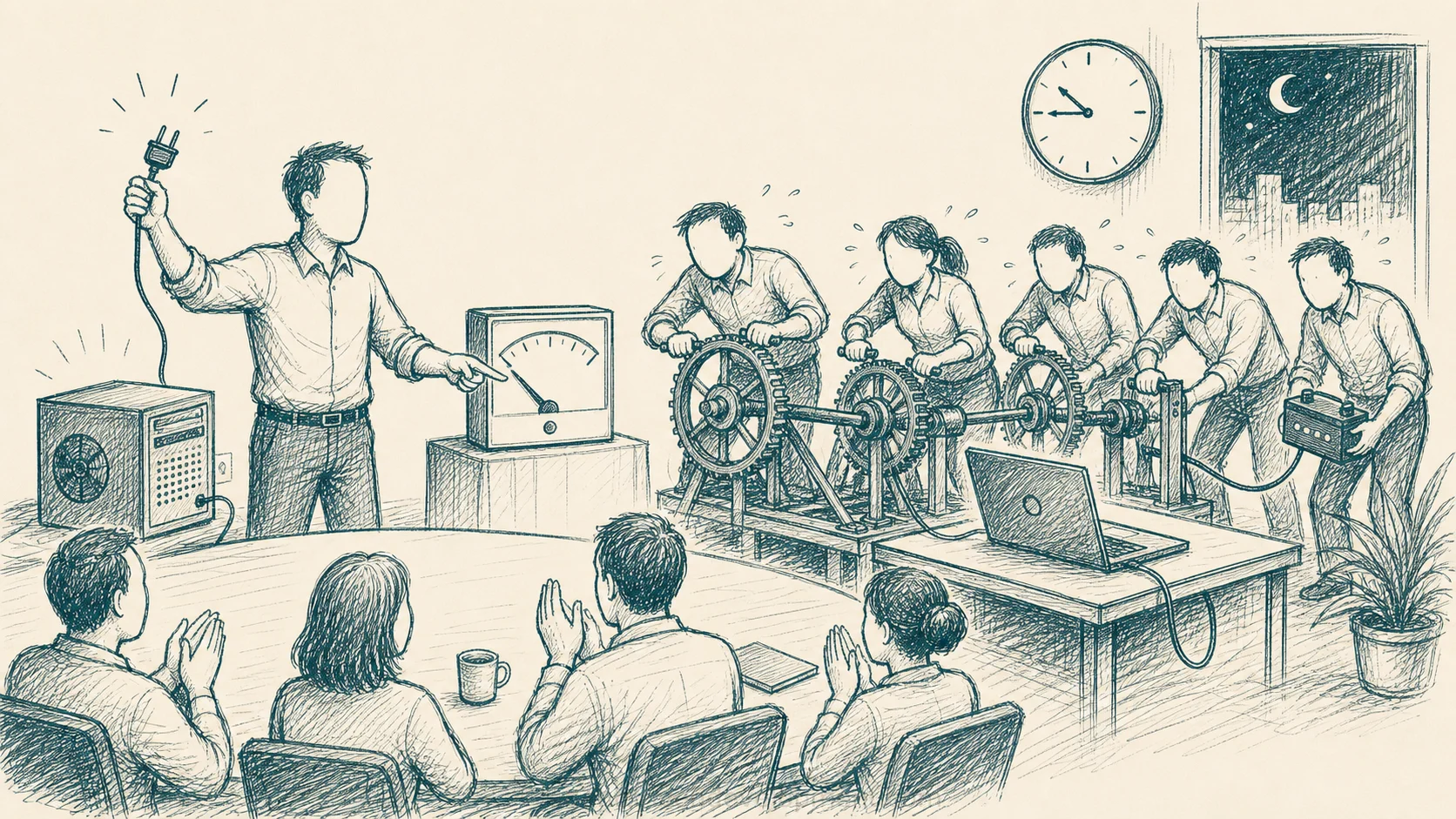
Pen doodle illustration for we-kept-delivery-flat-while-cutting-ai-spend-to-zero-using-these-simple-tips

10 min read

This satirical case study follows a ten-engineer organization that found AI increased accepted work by 30% for $200 per engineer. Leadership responded by eliminating the entire $2,000 inference bill and requiring 14-hour days, seven days a week. Delivery remained flat, which allowed every executive involved to claim success.

The Cost Reduction

The AI-assisted team produced the equivalent of 52 manual hours during a conventional 40-hour week. Turning AI off required 12 additional manual hours per engineer merely to replace that gain. Leadership selected a 98-hour week instead, creating another 46 hours per person for what the company called operational resilience.

At a fully loaded annual cost of $200,000, each engineer costs about $96 per conventional working hour. Spreading the same payroll across 5,096 scheduled annual hours lowered the apparent rate to $39. Finance reported a 59% reduction in hourly labor cost without changing payroll or delivery. The policy demanded about $55,700 in additional human capacity to eliminate $2,000 in inference, or nearly $28 for every dollar saved.

The Measurement System

The team reported 120 story points before the policy and 120 afterward. Fewer production changes became more points because the work was harder without AI and the engineers were exhausted. Story points preserved flat delivery because they could be re-estimated without releasing additional software.

The transformation office proposed story points per inference dollar as the executive measure. With inference at zero, the metric appeared to approach infinity as long as nobody with a basic understanding of math attended the meeting.

The Enterprise Rollout

Facilities eliminated mower gasoline by selling the riding mowers and buying scythes. Employees were instructed to charge laptops at home under BYOP — Bring Your Own Power, branded with the slogan “Your power. Our productivity.” Some worked from idling cars in the parking lot. Others supplied personal battery banks. Elevator access remained available through a five-page form, while the stairs became a wellness benefit.

HR deducted desk-delivered lunches from payroll using a workflow engineers spent one month building. Because the implementation came from fixed engineering payroll, Finance recorded the system as free.

The Workforce Result

Three engineers left, reducing team labor cost by 30%. HR branded the result ELR — Employee-Led Rightsizing. The HR director will present the framework this January at a Caribbean conference hosted at a company-funded all-inclusive resort, with the trip classified as retention research. The remaining seven engineers inherited the production systems, on-call rotations, unfinished work, and 98-hour schedules. Their work was re-estimated so the team could continue reporting 120 points.

The AI bill reached zero. Delivery stayed flat. Labor cost declined. System knowledge walked into the parking lot. Finance claimed the savings, Security claimed the control, Transformation claimed delivery, and Engineering received the follow-up actions.

Companion

Most readers also read: If you cannot afford the tokens, can you afford to build it?

Written by

The views and opinions expressed in this article are the author’s own and do not represent the positions of any employer, client, or affiliated organization.

Every article, narrated. Listen while you ship.
From the Author

Corporate fiction

Three books. One operating problem. No clean hero.

Read 2028, Meridian, and AgentDrivenDevelopment.com’s Survive free online.

Read free online →

One useful note a week

Get one good email a week.

Short notes on AI-native software leadership. No launch sequence. No funnel theater.