12 min read
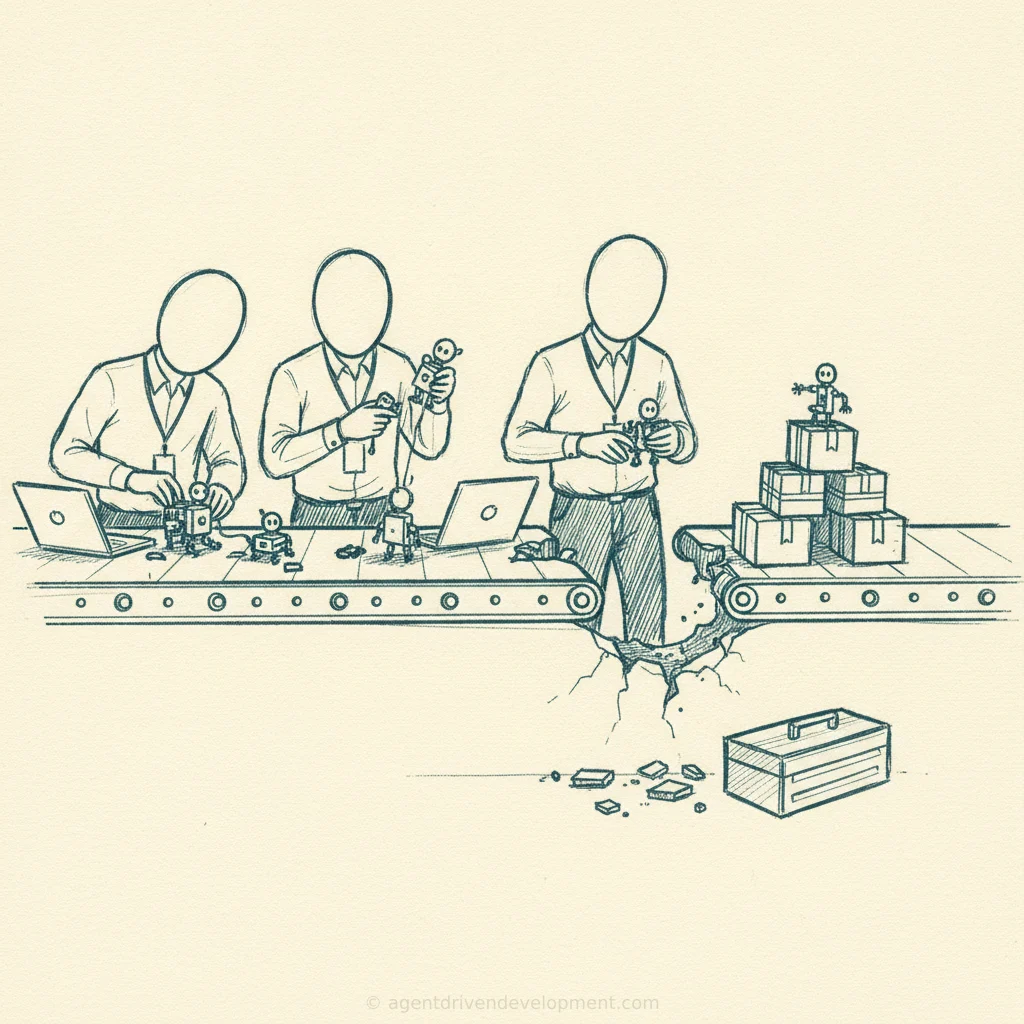
AI investment can improve coding speed while leaving delivery almost unchanged. When repositories accumulate agent instructions but still lack reliable tests and deployment automation, leadership should investigate what the team is improving and what it is allowed to change.
Establish a working delivery process before the next product change
The premature primitive problem is the investment in reusable skills, prompts, and agent definitions before the team has a reliable way to verify and deliver the software those agents will change. Agent instructions are useful when they describe a process that actually works. They cannot compensate for missing automation or unresolved ownership.
Start with source control. Find repositories accumulating agent instructions, follow references to shared build and deployment pipelines, and review what happened to the tests over the same period. Use the history to find contributors and ask about their work. Timestamps cannot establish effort or motives. Engineers may be improving the only files they can change without another team's permission.
Walk one actual change from a clean checkout into production. Identify manual verification, unreliable tests, handoffs, and approvals. Repair the demonstrated constraint: more tests will not resolve a release approval that nobody answers. If an engineer needs help learning test automation or applying AI to the repository, work through it together. If another team owns the pipeline, leadership must resolve access and priorities.
Before the next product-code change, establish the intended behavior in the affected area and automate useful checks. Investigate disagreements between requirements and implementation instead of preserving every existing answer. Run the checks in CI, build and deploy the existing version through a repeatable process, verify it in a test environment, and demonstrate recovery from failure. This is a useful baseline for the software about to change, not a demand for perfect company-wide coverage.
Use MinimumCD and Bryan Finster's published guidance to help the team and its agent inspect the repository. The agent still needs human judgment about expected behavior. Mutation testing can reveal whether tests catch meaningful faults. For example, changing free shipping from at least $100 to more than $100 should cause a test at exactly $100 to fail. A mocked calculator may hide that behavior.
Measure the complete result. In the article's hypothetical, two days of coding plus eight downstream days become one plus eight: ten days become nine. A 50% coding-time reduction does not halve delivery time. Recovered capacity and quality improvements may have value, but saved time is not automatically cash savings, and sooner delivery must serve a customer need.
Give one team time and authority to repair the demonstrated obstruction. Name the owner, decide which existing commitment moves, and follow the next comparable change. Look for less waiting, earlier detection of problems, repeatable deployment, and a useful customer result. AI adoption requires those leadership decisions as well as subscriptions.
Companion
Most readers also read: Stop Reviewing Code. Start Proving It Works. My Take on AI in the Quality Process of Software.


