7 min read
A senior leader at a large organization told me his engineers' monthly AI inference allowance was worth less than one Starbucks drink every other working day. He could buy the team premium coffee every morning on the corporate card and nobody would care. Let the same engineers spend roughly that amount on AI inference, and they could face coaching or disciplinary action.
The company still describes AI as strategic. My friend is still receiving his maximum bonus. The incentives say the organization is performing exactly as designed.
The recommendation
If AI is too expensive, turn it off for 90 days.
Keep staffing, commitments, quality standards, security requirements, and service levels fixed. Remove AI from the work used to plan, build, test, review, document, migrate, and operate software. Measure accepted business outcomes, lead time, aging work, defects, incident recovery, senior review effort, customer impact, external capacity, and total cost to production.
The shutdown leaves leadership with three answers:
- If performance improves, leave AI off. It was accelerating weak portfolio choices, unnecessary output, review load, or poor quality. Then investigate the management system that aimed the acceleration in the wrong direction.
- If performance declines, price the lost capacity. Do not compare the inference invoice with zero; compare the AI-assisted production system with its replacement.
- If nothing changes, software production was not the constraint. The gain disappeared inside architecture queues, security gates, product ambiguity, release coordination, or an organization whose economics are disconnected from delivery performance.
The economics
A fully loaded senior engineer costing $180,000 a year represents about $87 per working hour. A six-dollar model run needs to return roughly four minutes to break even on labor capacity. A manager can consume more than the alleged savings in one coaching conversation.
The AI Coffee Allowance is not governance. It is anxiety with a receipt. Govern model routing, data boundaries, risk, and accepted outcomes. Do not celebrate eliminating a six-dollar variance while preserving a six-week delay.
The leadership signal
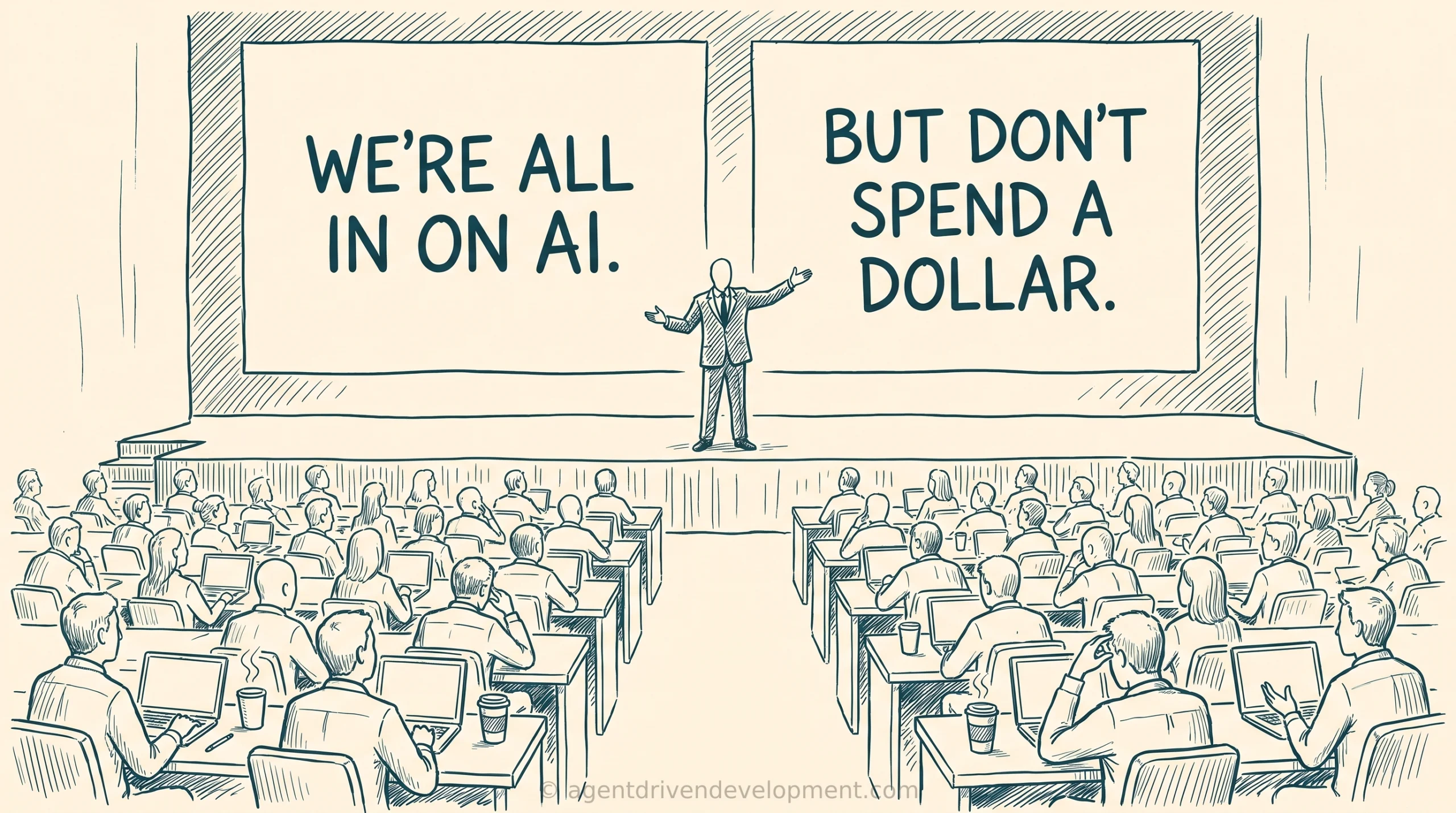
When the all-hands slide says WE'RE ALL IN ON AI and the operating policy says BUT DON'T SPEND A DOLLAR, employees know which message carries consequences. That is how an AI Center of Excellence becomes a Center of Normalcy: a function built to stop anyone from behaving differently enough to create an uncomfortable number.
My advice to the executive team is to run the shutdown and measure the business. My advice to my friend is different: follow the policy, protect company data, keep learning with approved access and personal work, collect the bonus, and use the skill to find a better job. This does not sound like an organization he can fix from his seat.
Companion
Most readers also read: If you cannot afford the tokens, can you afford to build it?


