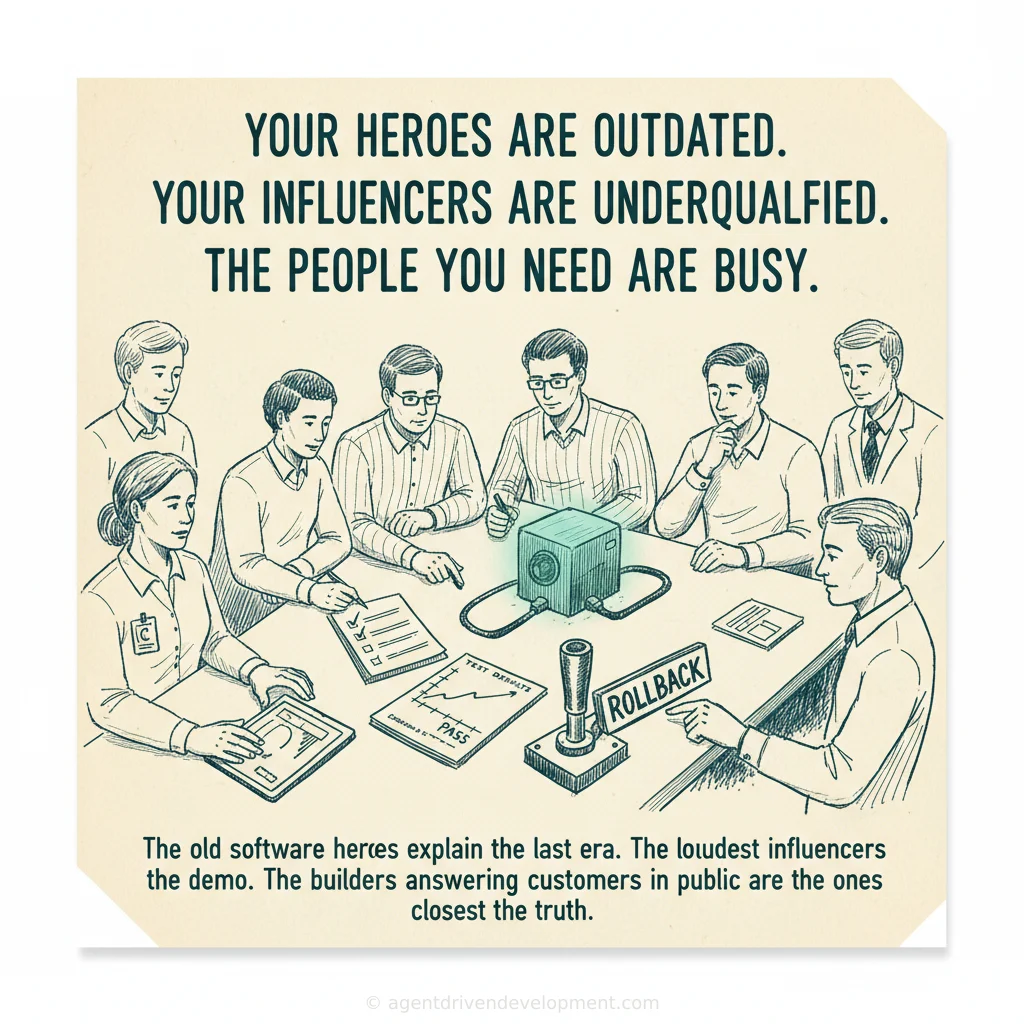
Your heroes are outdated. Your influencers are underqualified. The people you need are busy.
The old software heroes explain the last era. The loudest influencers explain the demo. The builders answering customers in public are the ones closest to the truth.
The cost of misapplied engineering attention is rarely measured, despite its pervasive impact on organizational throughput.
Establish clear signals for technology adoption.
The utility of information scales with its proximity to actual system constraints and operational consequences, not with its reach or presentation. Distinguish between market signal and actionable policy.
Industry trend analysis, while valuable for landscape awareness, becomes counterproductive when implemented as policy without internal system validation. Generalized observations do not inherently apply to specific, constrained environments.
Historical paradigms, captured in foundational texts, describe systems designed for human-centric workflows. These frameworks require re-evaluation and adaptation when integrating non-human agents into the development lifecycle.
Empirical research provides a methodical basis for evaluating technology claims, offering insights into actual performance and usage patterns rather than perceived benefits or anecdotal evidence.
Actionable insights for organizational change derive from those who bear direct support burdens and engage with system failures in production, rather than from content creators optimized for audience engagement.
An organization's operational policy must reflect its specific constraints, not generalized industry narratives or aspirational demos.
The cost of misapplied engineering attention is rarely measured, despite its pervasive impact on organizational throughput.
Establish clear signals for technology adoption.
The utility of information scales with its proximity to actual system constraints and operational consequences, not with its reach or presentation. Distinguish between market signal and actionable policy.
Industry trend analysis, while valuable for landscape awareness, becomes counterproductive when implemented as policy without internal system validation. Generalized observations do not inherently apply to specific, constrained environments.
Historical paradigms, captured in foundational texts, describe systems designed for human-centric workflows. These frameworks require re-evaluation and adaptation when integrating non-human agents into the development lifecycle.
Empirical research provides a methodical basis for evaluating technology claims, offering insights into actual performance and usage patterns rather than perceived benefits or anecdotal evidence.
Actionable insights for organizational change derive from those who bear direct support burdens and engage with system failures in production, rather than from content creators optimized for audience engagement.
An organization's operational policy must reflect its specific constraints, not generalized industry narratives or aspirational demos.
After 20 years in software development, Norman is both a hands-on leader and defining the new age of AI SDLC for some of the biggest brands in the world — and exploring it with the builders. He writes here about things he is hearing and seeing. All posts are his personal points of view and do not reflect any employer or any customer he has ever had contact with.
The views and opinions expressed in this article are the author’s own and do not represent the positions of any employer, client, or affiliated organization.