12 min read
The video is 36 minutes long.
The newsletter costs about the same as lunch each month.
The old books are still on the shelf behind you, where they have been since your first architecture role.
Between the three of them, you can feel like you understand the entire future of software engineering before your second coffee. The books give you the canon. The newsletter gives you the industry map. The video gives you the demo, the argument, the reaction, the stack opinion, the agent workflow, and the thumbnail that says this changes everything.
That is how a take becomes a strategy.
And that is how companies waste a year.
For a 200-person engineering org, losing 15 percent of one quarter to the wrong agent policy is roughly 200 x 520 hours x 15 percent x $90 loaded cost. Call it $1,400,000 of engineering attention pointed at the wrong operating model.
You can see the mechanism in Slack.
Someone drops the latest video into the engineering leadership channel. Someone else replies with the newsletter link. A staff engineer says the workflow looks promising. A director asks whether the team should standardize on it. By 3 PM, the conversation has moved from “interesting signal” to “maybe this is what we should do.”
That is the moment to stop.
Not because your team is wrong to pay attention. You want engineers who notice the market moving. You want directors who are curious. You want staff engineers comparing tools, reading papers, testing workflows, and arguing about whether agents belong in the terminal, the IDE, the issue tracker, or the CI pipeline.
But you are allowed to ask the executive question nobody wants to say out loud:
Do I care what this person thinks?
Not “do I like them?” Not “are they smart?” Not “did the demo work?”
Do I care what this person thinks about our operating model, our codebase, our review queue, our release controls, our customer contracts, and our ability to absorb change?
That distinction is everything.
If the answer is “they have taste, but they do not carry our constraints,” treat the take as signal, not policy. Your AI tool does not matter as much as your organization. Your codebase may not be agent-maintainable. Your code review process may need to become a verification system, because the answer is not to review more code by hand. And if your teams already went through the training and nothing changed, the problem probably was not the training. It was the missing standard, which is the argument in We Went Through the Training and We’re Not Seeing the Value.
Not because any of them is useless.
The newsletter is useful. It has sources. It finds patterns across Big Tech, startups, layoffs, compensation, AI tools, agent adoption, outages, and the weird internal machinery of software organizations. If you are an engineering leader and you do not read that kind of work, you are choosing to be surprised by the market.
The video channel is useful too. The person behind it has built things. Real things. Public things. A popular web stack. A chat product. A coding-agent control plane that people can fork, install, argue with, and use. That matters. This is not someone reading a vendor press release into a microphone.
But useful is not the same as authoritative. Useful can save you an afternoon. Authoritative can change your operating model.
And “has shipped something” is not the same as “should define your operating model.”
The paid newsletter gives you second-order truth.
That is not an insult. Second-order truth is valuable. A good reporter talks to people you cannot reach, collects stories you would not hear, and notices when ten companies are quietly hitting the same wall. When a serious newsletter says teams are running parallel coding agents, or companies are seeing AI-generated quality problems, or senior sign-off is returning because junior engineers over-trusted agent output, you should pay attention.
But you should know what you are reading.
You are reading synthesis. You are reading a selection function. You are reading a weekly product that has to turn messy industry behavior into something coherent enough that a senior engineer, VP, recruiter, founder, or CTO will renew.
That creates pressure.
The pressure is not to lie. The pressure is to make the industry legible. The pressure is to name the trend. The pressure is to tell you what is happening in a way that feels like a map.
Maps are useful.
They are not steering wheels.
You can read a breakdown of agent-caused outages and still have no idea whether your own team should let agents touch Terraform. You can read about parallel agent workflows and still have no idea whether your CI can absorb four simultaneous branches from the same engineer. You can read that companies are tracking AI usage in performance reviews and still have no idea whether token count means anything inside your delivery system.
The mistake is not reading the newsletter.
The mistake is letting the newsletter become policy before your own system has been measured.
I have seen this happen. An executive reads a sharp industry analysis on Sunday night. Monday morning, the team has a new mandate. “We need parallel agents.” “We need every engineer using this tool.” “We need to measure adoption.” Nobody has mapped the review queue. Nobody has looked at flaky tests. Nobody has asked whether the model has permission to edit billing logic, customer notifications, infrastructure, migrations, or compliance-controlled code.
The newsletter did its job. It made the market visible.
The company did not.
The old software-book canon gives you historical truth.
The refactoring catalog. The test-first discipline. The DevOps novel that turned value streams, queues, constraints, and technical debt into a story executives could finally understand. The clean-code shelves. The craftsmanship talks. The conference circuit. The workshop package. The consulting practice built around a vocabulary that every engineering leader eventually learned to repeat.
Those people were not useless either.
They made the last operating model legible. They gave teams words for problems they were already living with. They helped engineers argue for smaller functions, clearer seams, safer changes, better tests, faster feedback, less queue time, and fewer heroics.
That was real work.
But a book freezes a system at the moment the author understood it well enough to sell it. That is the quiet danger of the canon. The better the book was, the easier it is to forget that the world moved underneath it.
That matters now.
The last generation of software books assumed the next contributor was human. Maybe tired. Maybe junior. Maybe brilliant and insufferable. But human. The advice was built around human memory, human review, human pride, human communication, human team topology, and human limits.
Agents change that assumption.
When the next contributor is a model operating through a harness, a lot of old advice still helps. Tests still matter. Refactoring still matters. Small changes still matter. Fast feedback still matters. The old book sellers were right about more than they were wrong about.
But they were solving for a different reader.
They were not answering: should an agent be allowed to edit migrations? Should it create branches in parallel? Should generated tests count as evidence? What do you do when the model deletes the test to make the test pass? How do you measure output when code volume rises and review quality falls? What happens when a junior engineer can produce five plausible pull requests before the senior engineer finishes one careful review?
If the old canon is your foundation, good. A team with no memory is just as dangerous as a team trapped in 2008.
If it is your current map, you are late.
The papers give you slower truth.
Read them.
Read the papers from universities. Read the papers from labs. Read the field studies. Read the replication packages when they exist. Read the limitations section before you screenshot the conclusion.
The papers are not perfect. Some are late. Some use narrow samples. Some measure open-source work and then people pretend the result covers bank software, healthcare systems, game engines, and internal CRUD apps. Some study tools that are already obsolete by the time the PDF hits your feed.
Still, they do something most content does not.
They show their method.
One controlled trial in 2025 put 16 experienced open-source developers through 246 real tasks on mature repositories they knew well. The developers expected AI to make them faster. Afterward, they still felt faster. Measured time went the other way: roughly 19 percent slower with the early-2025 tools.
That does not mean AI coding tools are bad. It means the “I feel 40 percent faster” story is not enough to run a company on.
It means your feelings are not a metric.
Another large-scale study looked at coding-agent traces across 129,134 GitHub projects and estimated adoption between 15.85 and 22.60 percent only months after the category became mainstream. That does not mean every team is getting value. It means the behavior is spreading fast enough that pretending this is a fad is no longer serious.
A qualitative field study of professional developers used observations and surveys to show the same pattern from inside the work. Experienced developers were not just “vibing.” They were controlling design, supervising implementation, reviewing output, testing, using version control, running linters, and managing agents through small chunks of work. The job is not “the model writes code and humans disappear.” The job becomes supervision, proof, constraint-setting, and taste under pressure.
That is not as entertaining as a daily video.
It is more useful.
Papers will not tell you what to do Monday morning. They will give you a better floor for your argument. They make it harder for a newsletter, a book, a vendor deck, or a creator’s latest take to become the whole truth.
This is the least glamorous advice in the piece.
It may also save you the most money.
The video builder is a different problem.
This person is closer to the work. That makes the signal stronger and more dangerous.
If someone has built a tool for managing coding agents, uses it in public, ships releases, handles issues, and keeps the code open, you should listen differently than you listen to a pure commentator. There is product judgment there. There are constraints there. There are tradeoffs in the code.
But there is also an attention business wrapped around the builder.
A channel with a large subscriber base, a deep archive, sponsor inventory, daily publishing rhythm, and long-form episodes is not just a person sharing lessons. It is a media operation.
Media operations need motion. They need a plot.
They need the new tool to be interesting. They need the framework fight to be worth clicking. They need the agent release to matter today, not after six weeks of boring verification in three production systems. They need a title, a position, and a reason for you to watch now.
That incentive does not make the person dishonest.
It means you discount the certainty.
Do the math. If a creator publishes long-form technical content almost every day, records reactions, handles sponsors, ships clips, responds to comments, maintains a community, and also builds software, something is doing double duty. Sometimes the build is the content. Sometimes the content is the customer discovery. Sometimes the audience is the distribution channel for the product. Sometimes the product is proof that the audience should keep watching.
That can be a powerful loop.
It is not the same loop your company runs.
Your company has customer contracts. Data retention rules. SOC 2 controls. Legacy auth. A release window nobody likes. A migration from 2017 that still has three tables nobody understands. A staff engineer who knows why the retry logic is weird but is on vacation until Tuesday. A support queue full of customers who do not care that the demo was clean.
The video can show you a surface.
It cannot carry your consequences.
That distinction matters most when the content gets sensational. “This tool is over.” “This changes coding forever.” “Everyone is wrong about agents.” “I replaced my workflow in a weekend.” Maybe. Or maybe the creator found a strong workflow for a greenfield product, an open-source repo, a TypeScript-heavy environment, or a personal tool where rollback is cheap.
That is still useful.
It is not universal. Treating it like it is universal is where the damage starts.
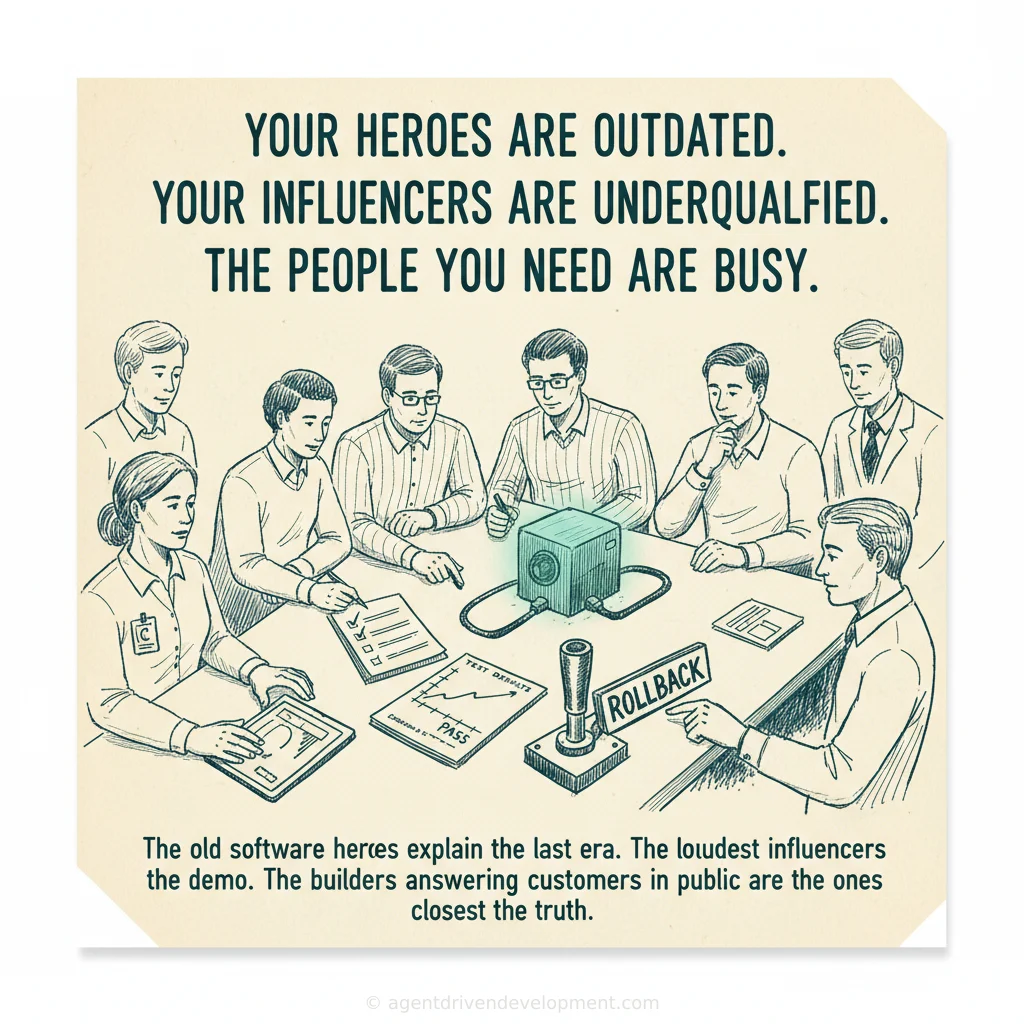
The best signal is usually quieter.
You see it on X at 11:38 PM.
Not the polished long-form thread with the hero claim. Not the daily video clipped into seven formats. Not the newsletter issue that turns a messy week into a clean trend.
The signal is the person replying to a customer who cannot get the agent to respect a config file.
The signal is the founder saying, “We shipped the patch. Pull 0.4.8 and tell me if Linux still breaks.”
The signal is the engineer posting a screenshot of the failed eval, not the polished benchmark chart.
The signal is the person asking a customer for the bad repo, the bad prompt, the bad trace, the failing test, the command that works on macOS and dies in CI.
These people are building in public, but not always performing in public.
That difference is important.
The builder talking to customers has risk in the conversation. If the claim is wrong, someone replies with a log file. If the product breaks, someone asks for a refund. If the agent deletes the wrong thing, the issue thread stays up. If the release is slow, the customer asks when it ships.
You learn more from that than from another thirty-minute monologue about the future of coding.
This is where the truth leaks out.
Pay attention to the people whose claims are attached to support burden.
Pay attention to the people who show the bug before the fix.
Pay attention to the people who say, “This worked for our docs repo and failed in the monolith.”
Pay attention to the people whose customers are in the replies.
There is a practical trust model here.
Read the newsletter for range.
It tells you what smart companies are trying, what Big Tech is willing to admit, what startups are quietly normalizing, and which failure modes are appearing often enough to deserve a name.
Read the old books for vocabulary.
They taught the industry how to talk about maintainability, feedback, flow, constraints, refactoring, testing, and delivery. Keep the parts that still survive contact with agents. Retire the parts that assume humans are the only authors.
Read the papers for method.
They will frustrate you. Good. Friction is useful when the alternative is letting a confident personality set your engineering strategy.
Watch the video builder for taste.
A good builder with a big audience will often see interface problems before enterprise buyers do. They will notice when a tool feels wrong, when a workflow is too slow, when a terminal stops being the right place for agent orchestration, when branch isolation matters, when one-button pull requests make a real difference.
Follow customer-facing builders for truth.
That is where the claims get tested. Not in the essay. Not in the reaction video. In the space between a release and a customer saying it still does not work.
Then bring all of it back to your own system.
Your codebase is not the newsletter’s codebase. Your customers are not the creator’s audience. Your deployment rules are not a demo environment. Your incident response process is not an open-source issue thread.
You need a policy that survives contact with your constraints.
Who can run agents? What can they touch? What tests must pass? What code paths require human review? What happens when an agent changes infrastructure? What happens when generated code increases support load? What happens when an engineer ships five agent-assisted pull requests and the reviewer becomes the new bottleneck?
Those are not content questions.
Those are operating questions.
I am not telling you to stop listening.
I am telling you to stop flattening every voice in your feed into the same category.
The newsletter person is an industry sensor.
The old book author is a vocabulary sensor.
The paper is a method sensor.
The video builder is a product and taste sensor.
The person on X debugging with customers in public is a reality sensor.
You need all of them, but you should not confuse them.
The people to pay closest attention to are often not publishing perfect long-form content every day. They are answering the uncomfortable reply. They are patching the release. They are explaining why the agent workflow broke when a real customer used it on a real repo with real constraints.
That is the new tell.
Not who sounds most certain.
Who is still there when the customer says it failed?
That is probably the person you should have been listening to all along.
Companion


