10 min read
I am on vacation watching parasails, which means I am supposed to be thinking about nothing.
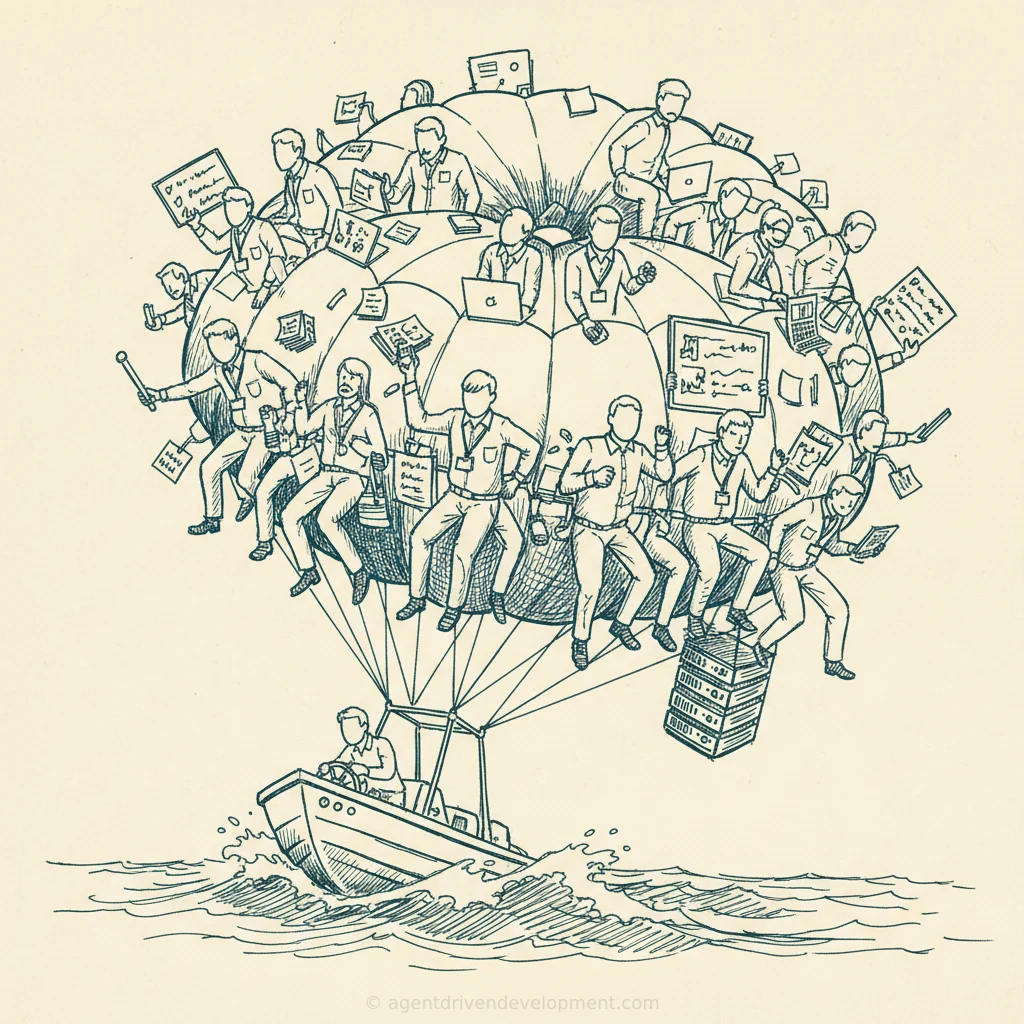
Every few minutes, another boat leaves the dock. A family signs a waiver. A credit card clears. Somebody checks the wind. The parachute opens, the rope tightens, and two tourists rise over the Florida water with the expression people make when they have paid good money to discover whether they are brave.
It is a simple business from the beach.
Boat. Weather. Waiver. Payment. Fuel. Crew. Insurance. Customer.
Then the career part of my brain, the one that ruins vacations, asks the question.
What if this were a Fortune 500 company?
Not a real one. Stay with the fiction because the fiction is doing work. Somehow you cornered the parasail market for the entire Florida coast. Every resort books through you. You bought the smaller operators from Key West to Destin. You are public now, absurdly, and your ticker scrolls between a chip company and a bank.
You are the CTO.
Not the founding CTO. That part matters.
You were brought in after the company hit $100 million in revenue. The founders had already proven the business with a hodgepodge WordPress site, dock managers who knew which phone number to call, a booking vendor nobody loved, and local operating knowledge that never looks strategic until it is gone.
You saw the mess and you were not wrong. The website looked like twelve marinas had argued with one template. The booking flow leaked customers. Reporting was late. Nobody agreed what a completed ride meant after a refund, a weather hold, or a resort comp.
So you brought in a team and cleaned it up.
Then you kept going.
Ten years ago, you grew the agile department because delivery needed discipline. Then DevOps because releases needed machinery. Then product because someone had to translate dock reality into roadmap language. Each move made sense when it happened. Each one gave the company a more mature story to tell itself.
Now AI is here, and you are preparing to do the same thing again.
And because scale makes everyone feel like they need a more complicated story, you have a 500-person software organization.
Now make it more uncomfortable.
You outsourced the website. I probably helped you make that decision. Let the people who understand travel conversion run the storefront. You outsourced booking too. Let the booking vendor handle calendars, deposits, coupon codes, abandoned carts, and the seasonal nonsense of tourist scheduling.
Payments are bought. Waivers are DocuSign. Weather is a service. The ERP is bought. Fleet maintenance is vendor software with six ugly custom fields. HR, finance close, reviews, and text reminders are bought too.
And still, somehow, you have 500 people building software.
How did that happen?
Nobody was stupid.
A scheduling team appeared because the vendor scheduler did not understand seasonal crew constraints. A data team appeared because every region defined utilization differently. A platform team appeared because the data team needed pipelines. A mobile team appeared because dock managers hated the vendor UI. Integrations appeared because the ERP, booking system, waiver platform, payments provider, weather service, insurance portal, and maintenance system all disagree about what a completed ride means.
Then reporting appeared because the board wanted a dashboard. Transformation followed because the dashboard exposed inconsistencies. Product operations followed because each region believed its exception was strategy.
Just the slow accumulation of reasonable decisions around a business that may not have needed that much internal software in the first place.
If the COO read that sentence, she would probably nod and hate herself for nodding. She knows which region still texts schedules because the “enterprise operating layer” is too slow at 6:15 in the morning. She knows the marina does not care whether the data platform hit its milestone if the boat leaves late anyway.
If the CFO read it, he would ask the question nobody wants on the slide.
“How much of this spend would I miss if I bought the better vendor next year?”
He does not hate software. His job is to ask whether capital earns its way back.
At 8:00 a.m. Monday, your software organization quits producing new software.
Nobody abandons production. Nobody ignores security. Credit card machines still work. DocuSign still takes waivers. The outsourced website and booking page still work. The weather service still sends wind and lightning data. The ERP still closes the books.
Your team still patches vulnerabilities. They still fix incidents in systems they actually own. If the booking vendor has an outage, they escalate. If the waiver integration breaks, they fix the handoff. If a terminal fails at the marina, somebody swaps it.
But for ninety days, the internal software organization stops changing the business.
No new crew-allocation dashboard. No rewrite of the maintenance workflow. No phase two of the ERP integration. No AI assistant for dock managers. No regional revenue cockpit.
How long until the stock price notices?
Jira notices immediately. The VP of Engineering notices too. His calendar is built out of dependencies.
But the stock price? The customer? The resort partner? The insurance carrier?
Do boats leave the dock less often? Do customers fail to sign waivers? Do cards stop clearing? Do boats sit idle in July? Does a storm-risk workflow fail in a way your insurer can price?
Or does the backlog get quieter while the company mostly keeps selling rides?
Do not get cute with this question.
The waiver archive is not ornamental. The incident log is not ornamental. The safety checklist, the weather hold, the maintenance evidence, the audit trail after a bad afternoon on the water. If they fail, the insurer, the lawyer, and the family on the dock all understand software very quickly.
That is what makes the rest of the portfolio harder to defend.
Once you name the systems that really do carry risk, what are the other 400 people doing?
This may be why the board is not giving you the AI money.
AI may not be the thing being doubted. AI is valuable. Painfully valuable. It lowers the cost of producing software and gives good people more reach than process diagrams ever did.
But valuable for what?
If the margins are big enough, if the boats are full enough, if the outsourced booking page converts, if the credit cards clear, if DocuSign stores the waiver, if the weather vendor carries the forecast, what exactly is the board funding when you ask for more AI budget?
The CEO may not be confused. She may be balancing two facts: AI is real, and your software organization may not be where the next dollar of enterprise value lives.
The board has an uglier slide.
Eighty percent of revenue still starts from things your software organization barely touches. A plane dragging a banner over the beach at 1:15. A tourist typing “parasailing near me” into Google. The giant words on the side of the boat. The resort concierge who says your company name because the commission clears and the customers come back smiling.
How much AI budget does the board give the CTO when the board believes the growth engine is a banner plane, a search result, and a boat with the right words painted on it?
The board’s alternative list is not sophisticated. That makes it dangerous: better coupons, better boats, brighter lettering, more banner-plane hours, a bigger Google local-search budget, higher concierge commissions, more reliable engines, a teenager in a branded shirt handing out flyers near the parking garage.
That list sounds unserious until it beats your roadmap.
What if the board took twenty people from software, put them outside with flyers that did not even have coupons, and revenue moved more than it moved from the last platform release?
What if the scrum masters became boat captains? They are already certified to lead. Different water, different consequences. The training might take more than a two-day class, and the Gulf will not accept a facilitation badge as proof anyone knows what to do when the wind changes. Still. If five got licensed and put boats in the water on Saturdays, would revenue move more than it did from the last operating-model workshop?
What if the most financially productive thing your software organization could do next quarter is leave the building?
Maybe if the software organization were 30 percent of its current size, the board would invest.
One hundred and fifty people. Sharp systems. Clear ownership. A small enough surface area that an AI dollar has somewhere to land.
But at 500 people, every new AI request looks like the next department. More headcount. More enablement. More training. More platform teams. More employee discounts on parasail rides eating margin while full-price customers wait on the dock.
Maybe the board is not rejecting AI.
Maybe it is rejecting your reflex to turn every technology shift into another permanent organization.
This is when Don walks in.
You hired Don four years ago, after the DevOps transformation could not find the value it promised. Developer Productivity gave the miss a new name. Don has defended the role since day one.
You do not have a Director of Parasail Captain Productivity. Nobody asks whether captains feel enabled to captain. But you have a Director of Developer Productivity, because software was allowed to build a productivity bureaucracy around itself.
Now Don has a plan.
Buy hardware. Build your own AI coding harness. Run open-source models. Own the stack. Control the data. Bring inference costs down.
Don has a rack diagram, a unit-cost chart, and a paragraph about sovereignty that sounds better each time he says it.
In a different company, maybe this is the right argument. In this one, it lands like a man asking for cheaper wrenches while the board is deciding whether it needs a machine shop.
The five-year hardware cycle should kill the idea. Models and workflows move before depreciation finishes its second lap around finance.
Except that is not what kills it here.
The five-year hardware cycle does not slow your velocity because your organization is already slower. Release review is slower. Vendor review is slower. Quarterly planning is slower. Don can buy the wrong GPUs and still discover that the bottleneck is not the rack.
The CFO is looking at banner-plane spend, Google search volume, boat utilization, and concierge commissions. Don is explaining GPU depreciation.
Don wants to spend more on hardware to save money on tokens than it would cost to refurbish the entire fleet of boats.
The problem is not that Don is optimizing the wrong model. The problem is that Don is optimizing the cost of producing code the board has not agreed is worth producing.
This is about value capture, not AI being useless.
I have watched four of my friends build a new product line in a month with AI. Not slides. Product lines. You can see versions of this all over X now, if you are willing to look past the people arguing about prompts and notice what is being shipped.
The AI worked. The question is whether your organization can use that speed.
Or worse, the organization could use the speed, and the market still would not care.
That is the sentence the CxO room keeps circling without saying. Not whether AI matters. Whether your software organization is important enough for AI to matter inside it.
The easy version says the board needs to be educated. Maybe. Or the board understands your company better than your AI slide.
Maybe they are not asking, “Is AI real?”
Maybe they are asking, “Why would we put AI money into this software organization?”
Those are different questions. The second one makes a CTO stare at the beach longer than he meant to.
This is the part that turns from budget question into career question.
You can spend years leading a software organization that is busy, respected, politically necessary, and not especially important to market value.
You can get promoted there. You can build teams there. You can learn the tone of voice required to make a dependency map sound like strategy.
Then AI arrives, and the old fog starts to clear.
The scary part is not the cartoon where AI replaces every engineer. The scary part is that AI makes it cheaper to ask whether the work should exist.
The outdated leader misses that because his reflex still comes from the last decade. Agile became a department. DevOps became a department. Product became a department. So AI must become a department too.
This time it may be bloat with better vocabulary.
If the stock would not notice ninety days of no new internal software, why would the board treat internal software as strategic?
If the business keeps running on outsourced booking, DocuSign, credit cards, weather feeds, and ERP, what is the 500-person software organization defending?
And if you are the executive asking for AI money, what exactly are you asking the board to believe?
That the company needs AI? Or that it needs your software organization to be the place where AI happens?
Those are not the same sentence.
Somewhere on the Florida coast, a boat is leaving the dock.
The waiver is signed. The credit card cleared. The weather is acceptable. The crew is ready. The parachute lifts.
The customer does not know whether your internal platform roadmap exists.
The market may not know either.
So if your software organization quit working, how long until the stock price would notice?
And if the honest answer is “longer than I want to admit,” maybe the AI budget is not late.
Maybe the career decision is.


