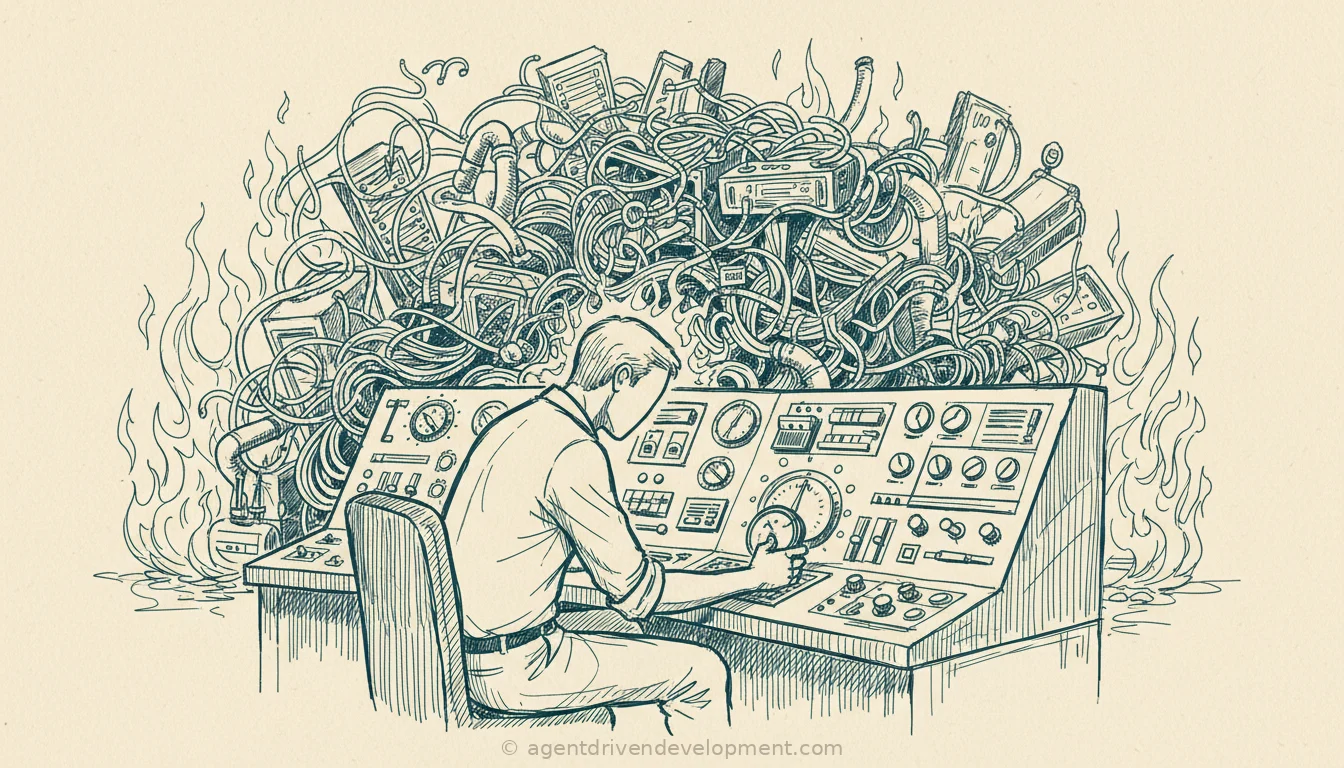
Your Codebase Is Not Agent-Maintainable and That Is Your Next Big Problem
Mike spent three weeks trying to get AI agents to maintain his Flink pipeline. The agents were not the problem. The code was not agent-maintainable. This is a new standard, and your codebase probably fails it.
Maintaining an AI-ready codebase requires explicit design for agent interaction, not just human readability.
Treat the codebase as a new team member.
Code maintainability for AI agents prioritizes conventional patterns and explicit declarations over cleverness or implicit understanding. Abstraction layers and metaprogramming, while efficient for humans, increase agent error rates.
Comprehensive, executable tests become formal contracts verifying agent behavior, shifting from mere quality assurance to a foundational mechanism for validating AI-authored changes.
Small, self-contained code units with minimal coupling are critical. Agents operate within context windows; cross-boundary dependencies dramatically increase inference complexity and defect rates.
Organizations must account for an "agent-hostile code tax" – the hidden cost of rework and debugging when agents encounter code patterns outside their statistical confidence intervals.
Regulatory and audit frameworks must evolve to track agent-authored code. Semantic errors from AI-generated changes pose new compliance risks for critical systems.
The new standard for software quality is agent-maintainability.
Maintaining an AI-ready codebase requires explicit design for agent interaction, not just human readability.
Treat the codebase as a new team member.
Code maintainability for AI agents prioritizes conventional patterns and explicit declarations over cleverness or implicit understanding. Abstraction layers and metaprogramming, while efficient for humans, increase agent error rates.
Comprehensive, executable tests become formal contracts verifying agent behavior, shifting from mere quality assurance to a foundational mechanism for validating AI-authored changes.
Small, self-contained code units with minimal coupling are critical. Agents operate within context windows; cross-boundary dependencies dramatically increase inference complexity and defect rates.
Organizations must account for an "agent-hostile code tax" – the hidden cost of rework and debugging when agents encounter code patterns outside their statistical confidence intervals.
Regulatory and audit frameworks must evolve to track agent-authored code. Semantic errors from AI-generated changes pose new compliance risks for critical systems.
The new standard for software quality is agent-maintainability.
After 20 years in software development, Norman is both a hands-on leader and defining the new age of AI SDLC for some of the biggest brands in the world — and exploring it with the builders. He writes here about things he is hearing and seeing. All posts are his personal points of view and do not reflect any employer or any customer he has ever had contact with.
The views and opinions expressed in this article are the author’s own and do not represent the positions of any employer, client, or affiliated organization.