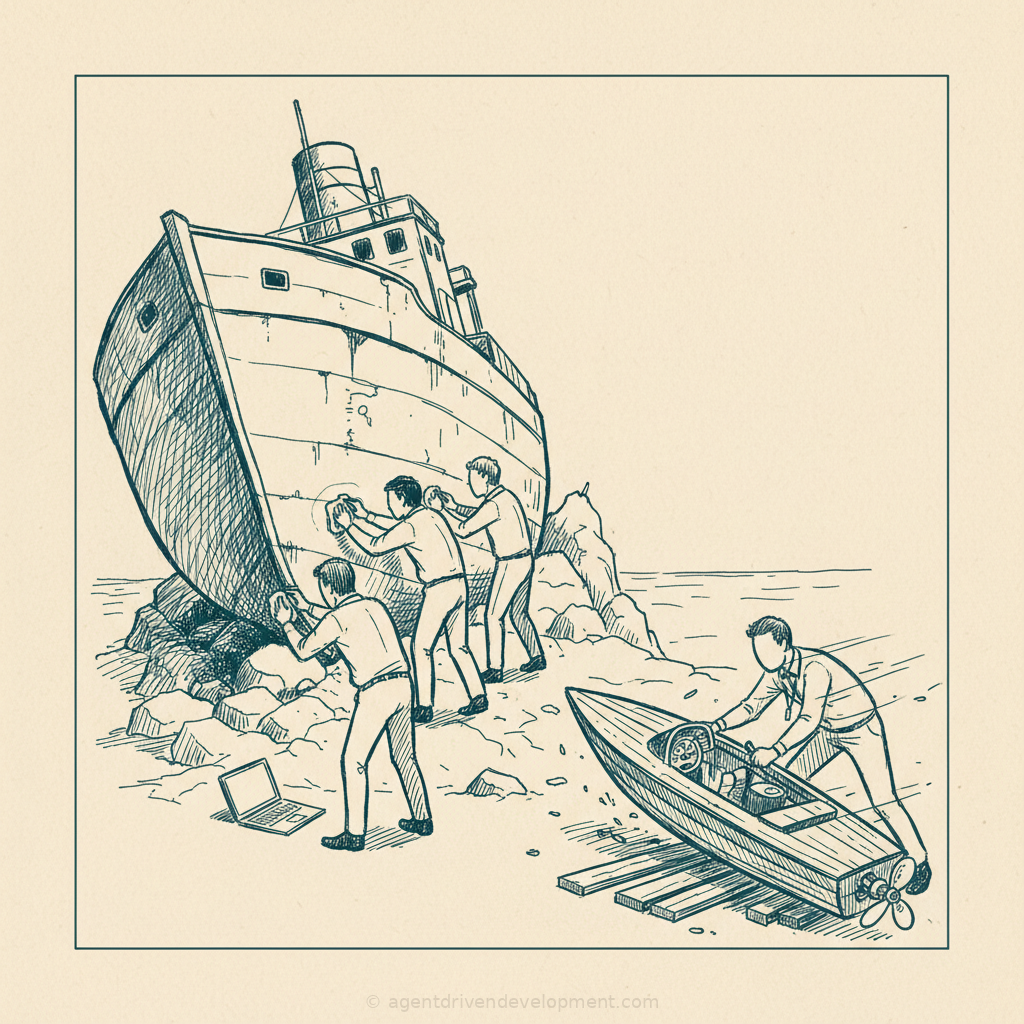
The Fifty Million Dollar Question, Stop Transforming. Start Building.
Every leader I ask the fifty million dollar question gives the same answer. They would not build what they have now. They would start over from first principles with something smaller, leaner, and faster. That answer tells me whether they…
Capability is the only durable AI moat. Tooling is rented; capability compounds.
Rebuild from first principles, not inherited structure.
Organizational design is a choice driven by underlying cost structures; as the cost of building software falls, the cost of coordination becomes the dominant drag on speed and capability.
Established organizational structures often reflect historical constraints and past problems rather than current realities or desired future states.
Small, empowered teams operating with clear objectives and minimal coordination overhead can outperform larger teams burdened by inherited processes and approval layers.
The true cost of software delivery encompasses not just direct build expenses, but also the significant overhead of coordination, process, and managing organizational complexity.
A strategic investment in a small, independent "parallel factory" team, distinct in governance and operating model, can demonstrate a fundamentally different competitive structure and delivery pace.
The first question for any organizational investment: does this action build capability or merely reinforce ritual?
Capability is the only durable AI moat. Tooling is rented; capability compounds.
Rebuild from first principles, not inherited structure.
Organizational design is a choice driven by underlying cost structures; as the cost of building software falls, the cost of coordination becomes the dominant drag on speed and capability.
Established organizational structures often reflect historical constraints and past problems rather than current realities or desired future states.
Small, empowered teams operating with clear objectives and minimal coordination overhead can outperform larger teams burdened by inherited processes and approval layers.
The true cost of software delivery encompasses not just direct build expenses, but also the significant overhead of coordination, process, and managing organizational complexity.
A strategic investment in a small, independent "parallel factory" team, distinct in governance and operating model, can demonstrate a fundamentally different competitive structure and delivery pace.
The first question for any organizational investment: does this action build capability or merely reinforce ritual?
After 20 years in software development, Norman is both a hands-on leader and defining the new age of AI SDLC for some of the biggest brands in the world — and exploring it with the builders. He writes here about things he is hearing and seeing. All posts are his personal points of view and do not reflect any employer or any customer he has ever had contact with.
The views and opinions expressed in this article are the author’s own and do not represent the positions of any employer, client, or affiliated organization.