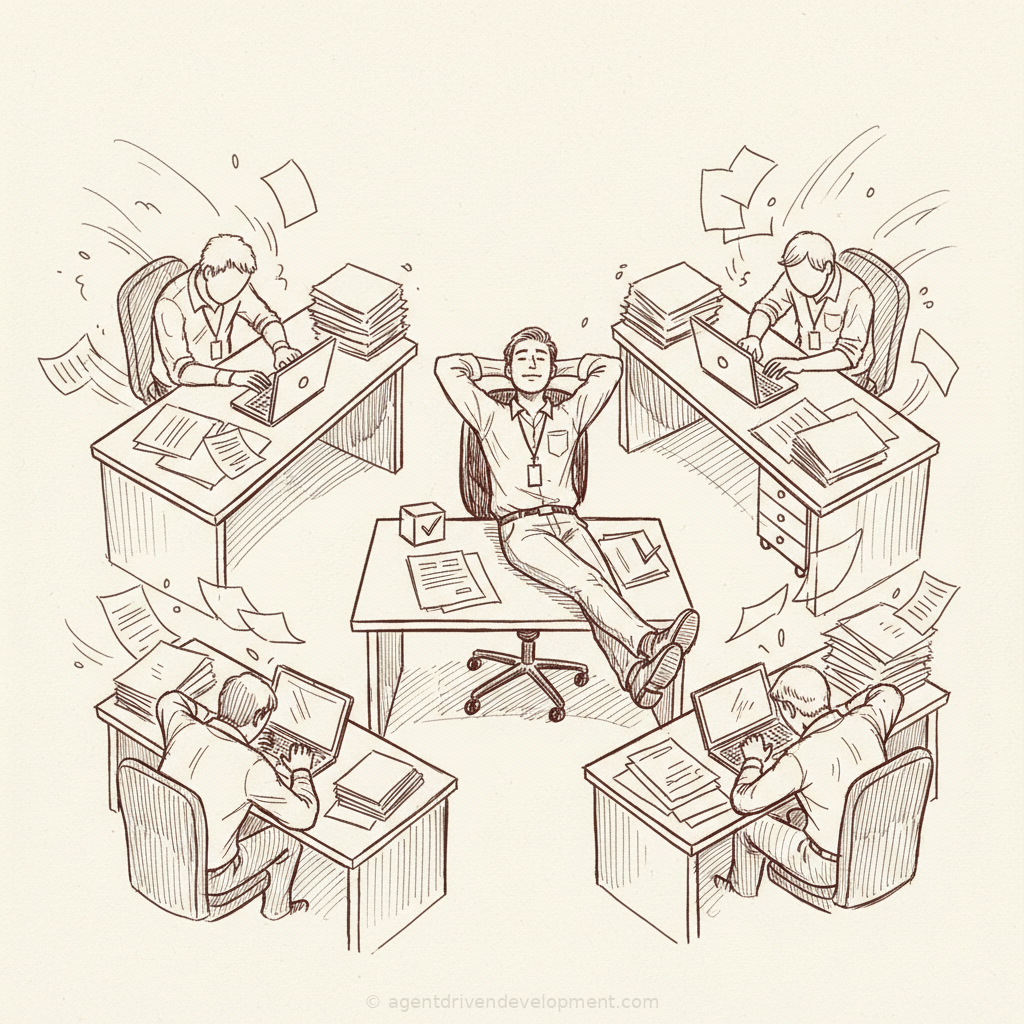
Congratulations: You Just Reinvented Peter Gibbons from Office Space
A 2025 parody exploring how enterprise AI adoption recreated Office Space. Your measurement systems train top performers to do just enough. That is not their failure. It is yours.
Reward systems define organizational behavior. When incentives are misaligned with desired outcomes, the system trains its participants for mediocrity, not excellence.
Measure the system before you measure the people in it.
An organization's measurement framework directly shapes the behaviors it rewards. Metrics that prioritize activity over output cultivate a workforce optimized for compliance, not performance.
Investment in new capabilities, such as AI tooling, yields diminishing returns when coupled with an anachronistic governance model designed for older paradigms of work.
The most effective use of AI within the software development lifecycle requires autonomy and immediate feedback loops, minimizing external dependencies and handoffs.
Sustained high performance depends on the alignment of individual motivation with organizational goals, facilitated by systems that remove friction and enable flow.
Organizations must recalibrate their measurement and incentive systems to reward shipped outcomes rather than mere activity or tool adoption.
Reward systems define organizational behavior. When incentives are misaligned with desired outcomes, the system trains its participants for mediocrity, not excellence.
Measure the system before you measure the people in it.
An organization's measurement framework directly shapes the behaviors it rewards. Metrics that prioritize activity over output cultivate a workforce optimized for compliance, not performance.
Investment in new capabilities, such as AI tooling, yields diminishing returns when coupled with an anachronistic governance model designed for older paradigms of work.
The most effective use of AI within the software development lifecycle requires autonomy and immediate feedback loops, minimizing external dependencies and handoffs.
Sustained high performance depends on the alignment of individual motivation with organizational goals, facilitated by systems that remove friction and enable flow.
Organizations must recalibrate their measurement and incentive systems to reward shipped outcomes rather than mere activity or tool adoption.
After 20 years in software development, Norman is both a hands-on leader and defining the new age of AI SDLC for some of the biggest brands in the world — and exploring it with the builders. He writes here about things he is hearing and seeing. All posts are his personal points of view and do not reflect any employer or any customer he has ever had contact with.
The views and opinions expressed in this article are the author’s own and do not represent the positions of any employer, client, or affiliated organization.