5 min read
“Make it stop.”
That was the feedback. Word for word. From your biggest customer. The one whose logo is on your investor deck.
You shipped everything they asked for. Every feature request from the last four QBRs. The integration. The reporting module. The workflow automation they said was blocking their renewal. All of it. In one quarter.
Your VP of Engineering presented the deployment numbers at the board meeting and the board applauded.
And your biggest customer got on a call with your head of CS and said: “Make it stop. We cannot keep up. Every week something is different. My team does not know what the product does anymore.”
You finally built fast enough to terrify your customers.
The Bottleneck Moved
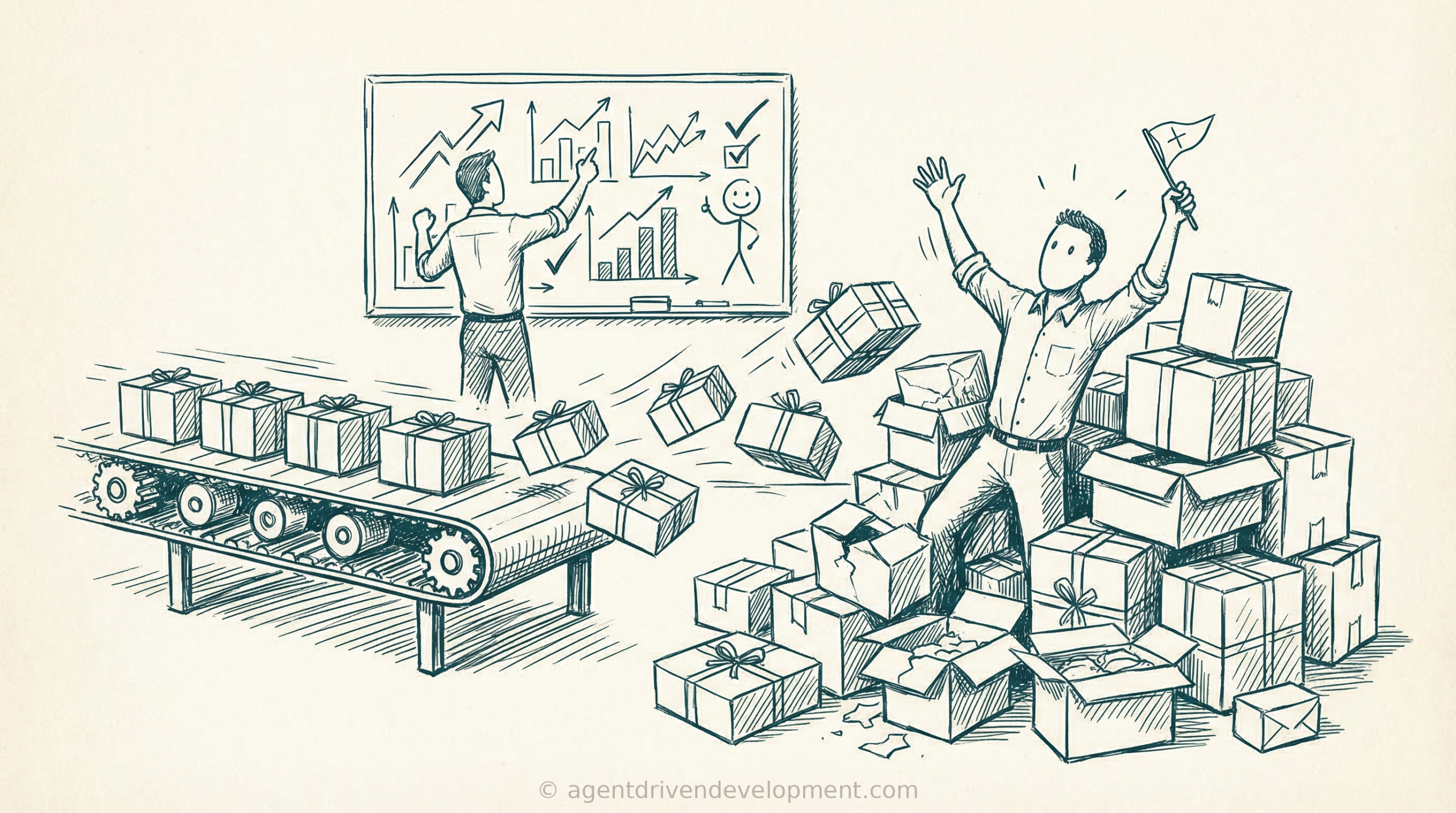
The engineering constraint is gone. With agentic tooling and proper guardrails, a modern team can ship a production-quality feature every day. I have seen teams do it. Two engineers outproducing ten. Not cutting corners. Shipping at a cadence that would have been absurd three years ago.
Most readers also read: The Engineers Who Can’t Use AI Agents Don’t Have a Tools Problem
Goldratt told you fifty years ago in The Goal — when you eliminate one constraint, another one emerges. Most executives celebrated removing the engineering bottleneck without asking what replaced it.
What replaced it is customer absorption — the rate at which your customers can receive, understand, integrate, and benefit from the changes you ship.
What the Gap Looks Like
B2B SaaS. Thirty-eight major features shipped in Q4. Customers adopted nine. NPS dropped eleven points. The other twenty-nine features sat in production generating zero customer value.
Healthcare. Seven clinical workflow updates in one quarter. Nurses in three departments reverted to paper by week eight. Patient safety incidents ticked up — not from bugs, but from staff using half-learned features during shift handoffs.
Manufacturing. New analytics dashboards every two weeks. By month four, supervisors were ignoring all of them — including the ones they asked for. The $1.4 million investment was technically live and functionally dead.
Financial services. Twelve compliance features in six months. The risk team incorporated four into their control framework. Eight were live in production but missing from the bank’s compliance documentation and audit trail. Attack surface nobody knew existed.
Same pattern everywhere. Engineering output increased. Customer absorption did not. The gap widened until it showed up as NPS drops, support spikes, safety incidents, compliance gaps, or churn.
The Economics
Your engineering organization costs $4 million a year. You ship forty features per quarter. Your customers absorb ten. That is $3 million a year in engineering output that shipped to production and died there.
It shows up as flat expansion revenue — customers cannot buy the upsell if they have not adopted the features that justify it. As rising support costs — “how do I” tickets climb 20-40% when you ship faster than customers can learn. As churn — “it just kept changing and we could not keep up.” And as security exposure — every unabsorbed feature is an unaudited capability live in production.
Training Debt
Every feature your customer does not absorb creates a gap between what your product can do and what they know it can do. That gap compounds. Feature 12 builds on feature 8, which builds on feature 5. If they never absorbed feature 5, the rest is not just unused — it is confusing.
Six months of aggressive shipping and your customer is using your product like it is 2024. Not because they are behind. Because you raced ahead without checking whether they were following.
A customer who missed one feature needs a five-minute walkthrough. A customer who missed twelve is evaluating whether to retrain or switch vendors.
And your own people accumulate training debt too. Your sales team cannot pitch features they do not understand. Your support team cannot troubleshoot capabilities they have never used. The gap shows up internally before it shows up externally.
What to Do About It
Do not slow down engineering. That would be absurd. Solve the receiving side.
Measure absorption, not just deployment. Time to first meaningful use. Adoption depth — not “clicked the button” but “completed the workflow.” Usage at day 7, day 30, day 90. These belong in your weekly product review with the same weight as cycle time.
Decouple shipping from releasing. Your engineering team ships every day behind flags. The release cadence — when features are surfaced and enabled for customers — is a separate product decision gated to what each customer segment can absorb.
Gate releases to absorption capacity. Build a customer readiness score from adoption telemetry, support ticket patterns, and time since last release absorbed. Customers still digesting the last release get the next one when they are ready. This is not slowing down. This is routing.
Use the Extra Capacity for Quality, Not Volume
If your customers absorb six features per quarter and your team can build forty, you have thirty-four features of capacity that will not land. Shipping those thirty-four is waste.
Use it to make the six you do ship perfect.
The MVP was a budget constraint dressed up as a methodology. When a feature took three sprints, you could not afford to polish before you validated. That constraint is gone. The MVP of 2019 can be built by an agent in an hour.
You now have the capacity to ship something complete. Real test coverage — not the 60% number that passes the CI gate. Performance that earns trust — 200 milliseconds, not 2 seconds. Documentation that exists. Migrations that do not punish your customers. Edge cases handled instead of filed as “v2.”
Volume is cheap. Quality is the competitive advantage. The organization that ships six features per quarter — each one polished, tested, and ready to absorb on contact — will outperform the one shipping forty features of half-finished slop.
Your next product review should include one question it has probably never included before.
Of the features we shipped last quarter, how many did our customers actually absorb?
If the answer is less than half, you do not have a velocity advantage. You have a warehousing operation.
The engineering bottleneck is solved. Now go solve the one that matters.
Real experiences from operators building with AI in the SDLC, including what worked, what failed, and what changed. Please feel free to use this, just attribute it to agentdrivendevelopment.com.


