11 min read
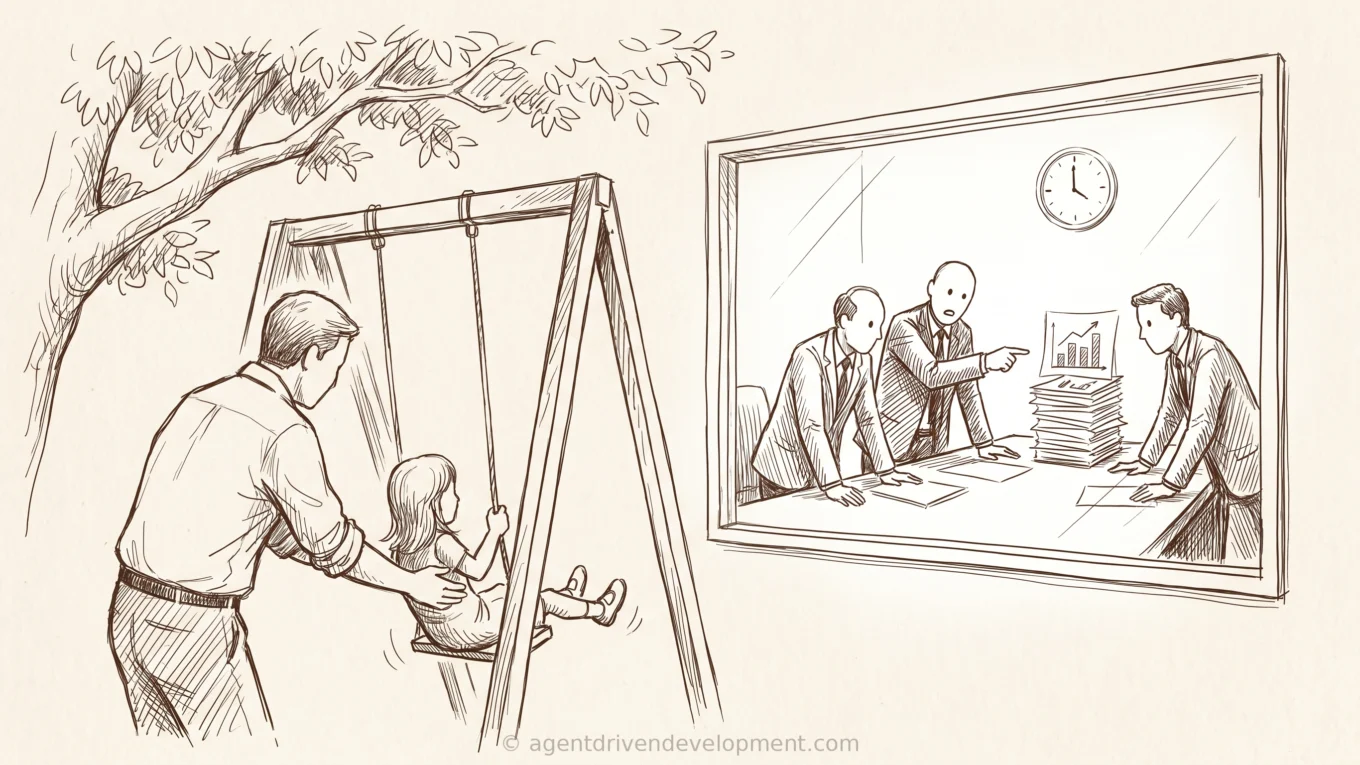
While our kids played on the playground last Saturday, my neighbor Bill (not his real name, and the company is going to stay out of this) told me a story.
Bill manages a software team. Fourteen engineers. He has been there nine years. He is the kind of engineering manager who still reads pull requests on the weekend, not because anyone asks him to, but because he cannot help it. His daughter is the same age as mine. They were on the slide. He was on his second coffee.
The story, stripped to its bones, goes like this. Bill’s $220,000-a-year engineers spent $500 in tokens. They shipped a record amount of work. The company’s official position is that this is a bad thing, and that it must be stopped.
Two months ago, on a Monday morning, the rate limits just were not there. Nobody knows who turned them off. Nobody has admitted it. The internal post-mortem narrowed it to “a configuration drift between the procurement contract and the identity layer,” which is the polite way of saying that the people who would normally know do not know. For five business days, three hundred engineers had effectively unlimited access to a frontier model. Bill’s team noticed by Tuesday afternoon. By Wednesday morning, the four most senior engineers had Slacked each other and agreed not to file a ticket.
What happened over the next four days is the thing Bill is going to remember when he is old. His team shipped more production-grade code than they had in the previous six months. A 2023-vintage backlog item rewritten and deployed. A flaky test suite, fixed. A deprecated SDK migration the team had quoted at “two quarters of effort,” done in three days with tests, docs, and a runbook. And the quietest engineer on the team shipped a change blocked for fourteen months on cross-team coordination, because the agent let her draft, validate, and walk the diff across four service repos in a single afternoon.
Bill said the energy on the floor was something he had not felt since he was a junior engineer in the early 2010s, when shipping software still felt like the point of the job rather than the residue of it.
On Friday afternoon, somebody in finance ran the variance report.
The bill was $42,000 against a budgeted line of $4,000. By Monday the rate limits were on, retroactive caps were issued, and the CIO sent an all-hands email about “responsible AI usage” and “approved budget envelopes.”
The CIO has never written code. His undergrad is in psychology, his graduate degree is an MBA, and his career has been built on org-chart literacy and a quiet talent for being in the room when the decision gets made. He is rational. He is competent at the thing he is hired to do. He is also two abstractions removed from the work he is now responsible for accelerating. It is the seat. The seat has been hiring for his profile for fifteen years. His job is the org chart, not the codebase. He looked at the variance report, did not open a single pull request from the week, and forwarded the report to his VP of Transformation with a one-line note: “We need to start measuring stories in tokens.” A meeting was scheduled to scope a new “AI Velocity Governance” workstream, with a steering committee, an intake process, and a dashboard. Bill was not invited.
The week cost $38,000 over budget. The week produced, by Bill’s accounting, four to six months of normal team output.
Bill did the math out loud while pushing his daughter on the swing. “Even on the most cynical view, even if half had to be redone, the company traded six months of fourteen engineers’ time, roughly one and a half million dollars of loaded labor, for $38,000 in tokens. And then they shut it off.”
He pushed the swing again. “Nobody is hiding it. The CIO knows. Procurement knows. They know what we shipped, what it cost, what they got. And the answer is still no.”
They were awesome. Almost nobody is paid to notice.
That is the part that should bother you.
Most readers also read: The Engineers Who Can’t Use AI Agents Don’t Have a Tools Problem
Almost nobody outside of sales gets paid for building business value. Sales has a commission plan that ties their paycheck to revenue closed, so a salesperson knows every Friday whether they made the company money or not. The rest of us get paid on proxy. Finance is paid on variance to plan. Procurement is paid on contracts negotiated and SaaS sprawl prevented. Security is paid on incidents avoided. Engineering is paid on delivery against a backlog somebody else owns. None of those proxies measure business value. All of them measure something the holder of the proxy hopes is correlated with business value, on a model nobody ever publishes.
Sure, lots of people have stock plans. RSUs, options, ESPPs. Those get you paid on market performance over a four-year vest, which is a proxy too — long, lagging, market-mediated, and disconnected from what you personally shipped last quarter. Stock is not base. Stock is not bonus. Base and bonus are what shape how you spend Tuesday afternoon, and base and bonus are what your function gets measured against when the budget request lands on somebody’s desk. The CFO does not look at the variance line and think “the stock will recover.” The CFO looks at the variance line and protects the line.
Imagine for a second that sales got the procurement function engineering gets.
Imagine sales kickoff was canceled because the venue line went over budget. Imagine the annual travel budget for an enterprise rep was capped at ninety-nine dollars a month and the rep was told to drive to the client meeting in Cleveland. Imagine the AE who just closed a four-million-dollar deal got an email from procurement asking her to use the corporate-approved restaurant for her next client dinner. Imagine the CRO writing a justification deck, in the second quarter, to upgrade the CRM to the tier that actually does what the team needs. Imagine a sales engineer running her live demo off a 256-gigabyte SSD because that was the standard issue six refresh cycles ago and procurement has not gotten around to it.
None of that happens.
Sales gets the tools because the company knows, with certainty, what sales does for the company. Kickoff is not a perk. The travel is not a perk. The client dinner is not a perk. They are the cost of operating the function that closes the revenue line, and finance funds them as such, because the sales proxy and the business outcome are the same number on the same row.
This is not a slight about sales. The opposite. Sales got this right decades ago: tie comp to the outcome, fund the tools the function needs to do the job, reward the people who hit, and stop pretending the line items that make any of it possible are perks. That model works. Your $500-a-month token budget is not the ping-pong table in the lobby. It is the same kind of line item as the sales kickoff. Fund the high performers. Reward the high performance. Stop debating whether the function deserves the tools to do the job it was hired to do.
Engineering builds the product that sales sells. The proxy and the outcome are not the same number, and nobody at the budget table has agreed they ever will be. So the $500 a month per engineer in tokens is a fight. The seven-figure sales kickoff in Las Vegas is not. They are both line items the function needs to do the job. One is funded as such. The other is treated as discretionary spend layered on top of the labor line, and that asymmetry is the whole post.
To be clear, the asymmetry is not an argument that every token request should be approved. If your team is burning a boatload of tokens and not producing measurable value, the no is the right answer. So is the “not yet,” until you build a measurable plan that lets the spend be evaluated against an outcome instead of a feeling. Fund the function the way you fund the function that already produces revenue: with a real metric attached, the high performers identified, and the spend tied to what they ship. If the metric does not exist, build the metric first, then ask. Bill’s team has the metric. The unlimited week is the metric. Most teams are not in that position yet, and most teams should be building the case before they file the request, not after.
Bill’s team produced six months of business value in five days. Not one of the scorecards in the building measures that. The scorecards measure the proxies.
And the people holding the proxies cannot agree on which proxy is the one.
The math.
A senior engineer on Bill’s team costs roughly $18,000 a month, fully loaded. Two hundred and twenty thousand dollars a year. Base salary, benefits, RSU vest, payroll tax, the laptop, the on-call stipend, the IDE seat, all of it. Fourteen of them. About $260,000 a month before a single line of code ships.
Bill is asking for $500 per engineer per month. Seven thousand for the team, $84,000 annualized. The cost of one engineer for five months, against a 25-to-40 percent productivity lift on the code-shipping slice of fourteen engineers’ time, every month from here.
And the 25-to-40 percent is the conservative estimate, the steady-state version. Bill is not estimating. Bill has the data from the unlimited week: four to six months of normal output in five days. Discount it eighty percent for novelty, selection bias, and the fact that the most-blocked work happened to clear first, and the residual is still four to five times the team’s normal pace. At four to five times pace, $84,000 a year is buying back the productivity equivalent of fifty-plus engineers against a team of fourteen. The ratio is not subtle. Bill has already justified the spend, in his own company’s usage logs, against his own company’s variance report. The math does not need a meeting. The meeting needs the math.
Then the second-order effect, which finance does not have a column for. Senior engineers in this band cost $250,000 to $400,000 to replace. Baseline attrition runs eight to fifteen percent. Bill loses one or two seniors a year regardless. The denial does not change the rate. It changes the mix. The ones who leave are the ones with options. Those are the $400,000 ones.
The math does not work even on the procurement scorecard. Or, simpler: the organization has not metabolized the fact that the labor model changed, and the gap between the engineer with the right tools and the engineer without them widens every quarter from here.
The question Bill did not ask.
Why does your $220,000-a-year engineer not deserve $500 a month in tools?
Is it because $500 a month feels like a lot of money in a budget meeting and $18,000 a month does not, because the $18,000 sits on a different line item that is treated as fixed?
What I told Bill on Monday.
Do not resubmit the same request. Resubmission is how the no becomes a habit.
Get a named CTO sponsor for the line item before the next planning cycle. Sponsored line items survive review. Re-litigated line items do not. If the CTO will not sponsor it, that is also information.
Bring finance the receipt from the unlimited week. Your company has, in its own usage logs, the most expensive A/B test it will ever run. The control group is every other week of the year. The treatment group is five days. The result is in the variance report finance already wrote. Use it.
If that fails, write the memo that says you did what you could within the constraints, that the consequence is going to show up in Q3, and that you wanted it on the record.
I keep coming back to the swing. Bill pushing his daughter, telling me about the quietest engineer on his team finally being allowed to ship something she had been carrying in her head for over a year.
The thing he was describing was not a productivity gain. It was a permission. For five days, his team had been allowed to be as good as they actually are. Then the permission was revoked, and Bill went home and started shopping for a basement GPU.
What would your team do with five business days of unlimited access? If you do not know, your engineers do, and they have not told you, and they have stopped asking you about the budget. They are asking your HR partner about the moonlighting policy instead.
Postscript.
After I sent Bill those four prescriptions on Monday, he wrote back the same afternoon to tell me he had already moved past them. His team had generated a fresh token from the model provider’s portal, attached it to their coding tooling, and routed all of their AI work through it. The spend sits on a shared dev account, on a line nobody watches. Nobody noticed.
It works. Ironically, the system that said no cannot enforce its own no, because the system was built to govern procurement, and procurement is no longer where the work gets gated. Bill found a way to ship. That is what people who still care about shipping do when the official path closes.
The deeper irony: the new token bypasses the per-developer token economics entirely. The spend does not appear as engineering tooling. It appears as if the end customers of the product are using more AI than the model expected. The growth team is celebrating the engagement bump in their weekly review. The CFO is reading the same number as a leading indicator that the product is sticking. The dollars Bill could not get approved for his engineers are showing up on the company’s dashboard as proof the product is winning. The company will probably announce it on the next earnings call. The CIO who shut Bill down is not the CIO who reads that number, and the CIO who reads that number does not know what he is looking at.
Same dollars. Different column. One was a fight. The other is a win the company will brag about.
Companion


