8 min read
This is the conversation I would have with you in a hotel bar after the offsite. Not the polite version your peers give you in a QBR. The real one. Nobody on your payroll is structurally able to say it.
Sit down. I will buy the first round.
You told the board AI would compress delivery cycles by 30%. The CFO signed the budget. The CEO quoted you in the earnings call. Your name is attached to the number.
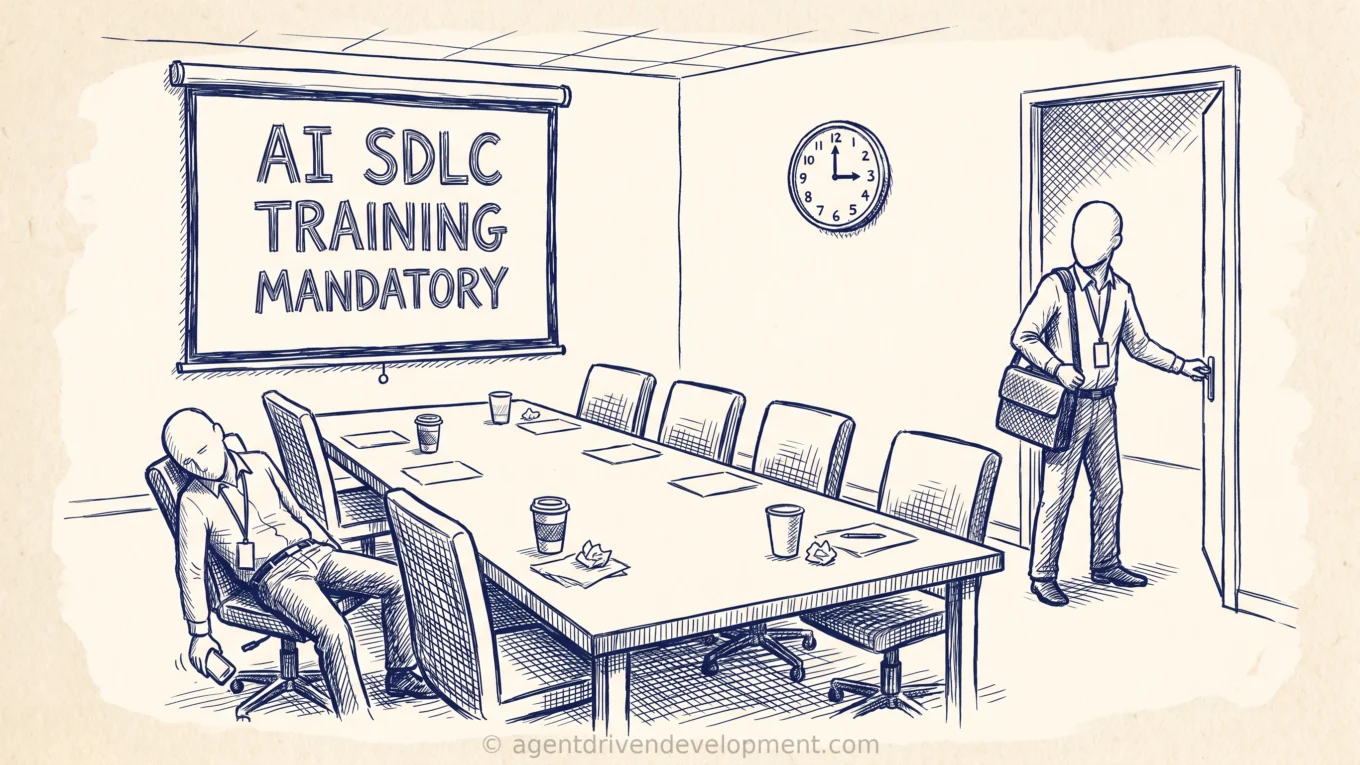
You scheduled the kickoff and the initial training sessions for 3 PM every Friday across the spring and summer. Every Friday. The one window where your engineers are actively trying to wrap, stabilize production, and not be here. Locked in, on the calendar, for months.
That is a indefensible decision. I am saying it out loud because none of your direct reports will. It is a indefensible decision made by a smart person who has not actually looked at their own calendar in six weeks, and the entire engineering organization knows it. The only person at your company who does not know is you.
At Least Bill Lumbergh Was Honest
Lumbergh leaned on the cubicle with his coffee cup and said “yeah, I’m gonna need you to go ahead and come in on Saturday.” It is a joke because he is a caricature. Inside the joke is something your organization has forgotten how to do. Lumbergh was honest about what important work looks like. Disrupted schedules. Personal inconvenience. A visible executive delivering the uncomfortable ask himself.
Most readers also read: The Engineers Who Can’t Use AI Agents Don’t Have a Tools Problem
You hid behind a Calendly link and outsourced the scheduling to L&D. Lumbergh was clumsy and coercive and it was still more honest than what you just did. At least Bill admitted that important work required inconvenience. You are pretending it does not. That is not leadership. That is conflict avoidance with an Outlook plugin.
Your Engineers Are Already Roasting You in Slack
The #ai-sdlc channel has a thread. Screenshot of the Friday invite. Laughing emoji. A Lumbergh meme. Somebody said out loud what the rest are thinking: “cool, guess we know how important this really is.”
You are not in that channel. That is also a signal. If you joined tomorrow, you would find a more accurate status report on your AI strategy than anything your direct reports are sending up the chain.
The Pattern. With Artifacts.
Your Agile transformation produced standups nobody runs on time, a Jira instance that takes fourteen clicks to file a ticket, and a retro template that has not changed since 2019. Your DevOps push produced a Jenkins pipeline three people understand, a Confluence page titled “CI/CD Standards v4 FINAL REVISED,” and a deploy frequency that moved from monthly to biweekly and flatlined for three years. Somebody still has a slide in the all-hands deck claiming DevOps maturity level four. Nobody believes it. Nobody takes it down.
You are about to produce the AI SDLC equivalent. Policy document nobody reads. Tooling license with a 14% activation rate. Responsible-AI steering committee that publishes minutes nobody opens. Compliance attestation the engineers fake because the real workflow they built works better than the approved one.
Same playbook, third time. Except this one has ROI the others did not. That is the part you have not processed.
A Seat Check Is Harder Than What You Just Did
A license seat check occupies you personally for an afternoon. You do one every quarter. The AI SDLC training? You delegated the scheduling to someone two levels below you, did not look at the slot, and signed off between other meetings.
Two hours across a 400-person engineering org at fully-loaded cost is north of $80K per session. Four cohorts puts you at a third of a million for one module, before vendor fees and coaching follow-on nobody has budgeted. You personally inspect the catering for the offsite. You do not personally look at this invite. Explain that to me in a way that does not make you sound like you are not paying attention. I will wait.
Now the number that is not in your training line item. The senior engineer who was excited about this. Built the prototype on their own time. Ran the brown-bag. That person watches the rollout, watches the 3 PM Friday invite, watches you not show up, and starts taking recruiter calls in Q3. Replacement cost loaded is north of $280K. Lose three of them, which is what happens when the pattern repeats, and you are looking at a million dollars of attrition produced by a scheduling decision your admin made in five minutes.
Put that line on the budget right under “AI Transformation.” See how it reads.
Will You Even Be There?
Open the invite. Right now.
Are you on it? Not “I’ll try to drop in.” On it. Accepted. Two hours. Laptop closed. Same terms you are asking of the engineers whose entire workflow you want to change.
If you are not, why would they be? Your engineers have a reliable algorithm for detecting what matters. They look at what the people paying them actually do. If you skip the training, the training is skippable.
Meanwhile the CTO two buildings over moved their AI SDLC program to Tuesday mornings in January. Mandatory. Sat in the first four sessions personally, cameras on. Their deploy frequency is up. Their recruiting funnel got easier because the word got around that this place was actually doing it. Your competitive position on AI is not your model budget or your vendor shortlist. It is whether your calendar matches your strategy. Theirs does. Yours is a PDF.
The Test Is Tuesday at 10
If this was the most important thing you were doing this quarter, when would you schedule it? Tuesday. Ten AM. Two hours. Blocking the calendar that is already full with meetings you have been too polite to cancel. You would send the invite yourself. You would move the QBR prep, the steering committee, the cross-functional sync that has run for two years and nobody remembers starting.
Something has to move. That is the whole test. If nothing moves, nothing was important. “Most important” is not a phrase you say. It is a calendar slot you defend. Only the executive team can defend it. Your directors cannot. Your VPs cannot. The L&D coordinator definitely cannot. The moment you delegated the scheduling of the thing you called strategic, you revealed that it is not.
Be Better Than Bill
I am not asking you to schedule it on a Saturday. That is cruel. Lumbergh was honest but he was also a monster about it.
Be better than Bill. Schedule it 10 AM Tuesday and make your department leadership move every other meeting to accommodate it. Not you personally. Them. If they cannot clear a two-hour block across their orgs for the single most important capability investment of the year, you have already learned something important about your bench.
It is also good practice. Moving the calendar is a dry run for what they are about to do anyway. You are about to change the governance model for software delivery, change the SDLC itself, rewrite how code gets reviewed, tested, deployed, and owned. Eighteen months. If your department leadership cannot move a set of meetings to make room for a training session, can they lead in the AI-SDLC age? Answer honestly. The calendar is the first test. Every test behind it is harder.
Here is the part that will sting. Your decade-old Agile transformation organization, the one with the coaches and the Scaled Agile certifications and the big visible board on the fourth floor, is going to make noise. Friday 3 PM is exactly when their teams do retros with the coach. Well, the half of the team that could not figure out how to escape the office fast enough, anyway. That is why the AI SDLC training landed there. It collided with the one recurring artifact the Agile PMO still protects, somebody did not want to have the fight, and the training got quietly bolted onto the same sad dead-end slot. They called it a scheduling win.
Honestly, the whole arrangement looks like something Bryan Finster would recommend on Scaled Agile DevOps MF — Bryan’s long-running parody site cataloguing exactly the kind of ceremony-over-outcome nonsense enterprise Agile programs produce. If you have not read SAD MF, go read it, then look at your Friday 3 PM invite and tell me with a straight face that it is not the punchline.
Move the retro. Move the training. Make both of them better. If moving a recurring retrospective to protect the capability investment of the decade feels like a crisis to your Agile PMO, you have just discovered another thing that needs to change. Write it down.
What to Do Monday Morning
Pull up next quarter’s calendar. Find every AI SDLC session, working group, pilot review, executive enablement block. If any of them sit after 2 PM on a Friday, after 3 PM on any day, or in the gaps nobody fought for, move them. Tuesday or Wednesday morning. Block 10 to noon. Put yourself on the invite. Put the entire executive team on the invite. Tell the people whose calendars you are disrupting why, in one sentence: “this is the most important capability shift we will make this year, I need you, and I will be there myself.”
Do it this week. Not next quarter. Not after the planning cycle. This week. The cost of delay is one more week of the wrong signal going out to every engineer you are trying to move, plus the compounding probability that the best of them reads it correctly and leaves.
This is the part where I put the glass down.
If the calendar does not move this week, the post-mortem is already written. I have seen this one before. So have your engineers. The only person who will be surprised by the outcome is you.
Lumbergh at least had the decency to say it to your face.
Check the invite. Are you on it? Good. Now move it to Tuesday.
Companion


