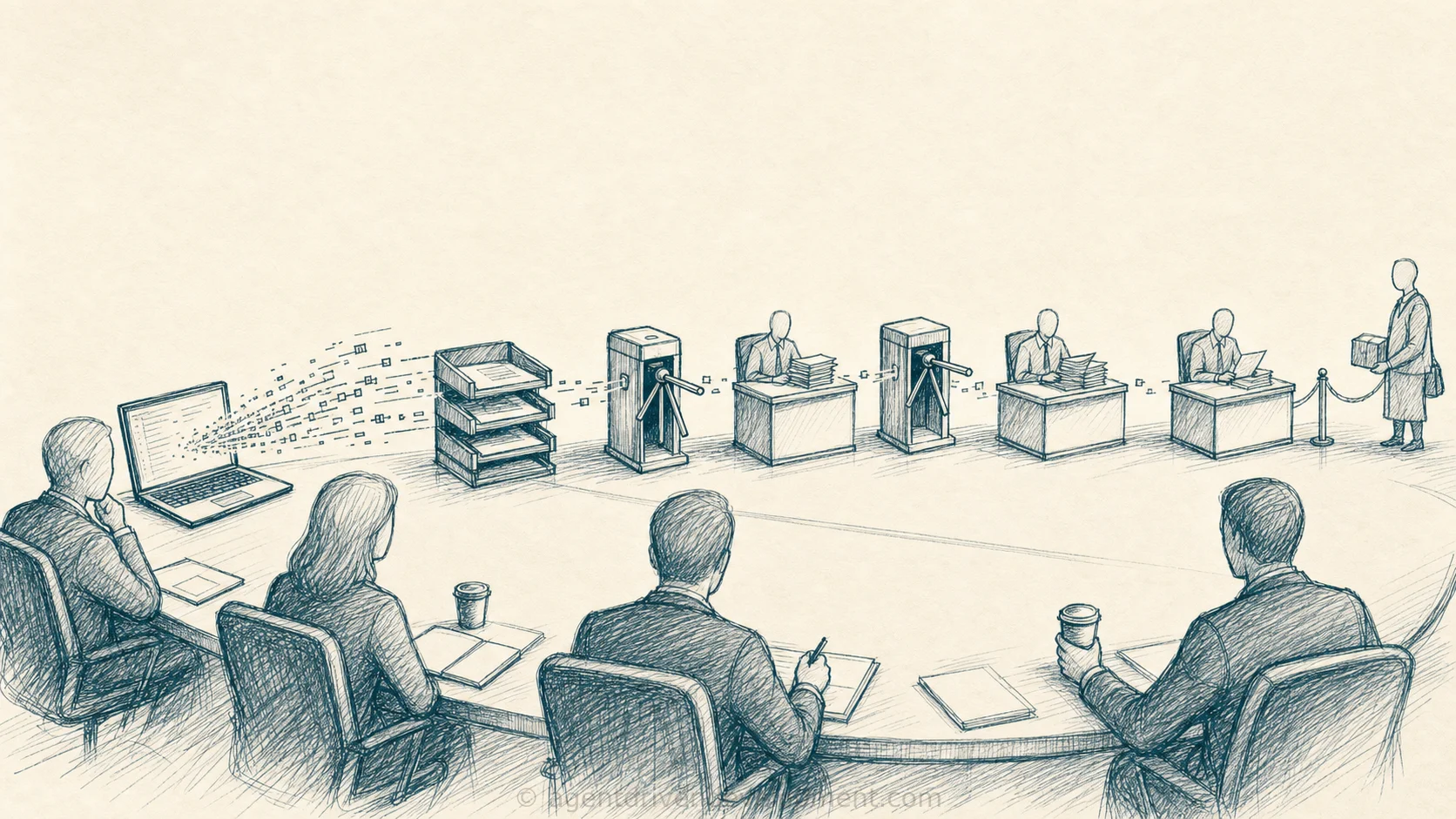
You bought the AI tools. Your engineers are using them. They tell you they are writing code faster. You see the pilot projects proving the productivity gains. Yet, your roadmap is not moving any faster. Costs are not going down. Customer impact remains unchanged. On Monday morning, you wonder, “What happened? Where is the speed? Where is the value?”
Executive Summary
- AI makes implementation faster, but company speed depends on removing systemic bottlenecks.
- Your organization’s operating model is the primary constraint, not a lack of AI tools.
- Traditional governance, verification, and product absorption processes become bottlenecks with AI-driven velocity.
- Capital allocation must shift from funding activities to funding demonstrable, auditable economic outcomes.
- Real economic impact requires redesigning workflows around AI capabilities, not just adding tools.
- Untapped productivity and innovation are trapped in organizational queues and handoffs, not technical limitations.
- Leadership must engage directly to reshape operating models, talent strategies, and governance for AI-native execution.
- Competitive advantage will accrue to those who can operationalize AI at an organizational level, not just at an individual level.
Core Thesis
Your company purchased AI tools to accelerate software delivery. These tools deliver on that promise by enabling individual engineers to write code and complete tasks with unprecedented speed. The problem is that individual productivity does not automatically translate into organizational speed. Your company’s operating model, designed for a different era of software development, creates queues and friction that consume all the gains AI delivers.
You have invested in a sub-five miler, but your relay team is still losing. The fastest runner cannot compensate for slow handoffs, poor strategy, or a team that cannot absorb the baton. The constraint has shifted. The bottleneck is no longer how fast individual work gets done; it is how fast the organization processes and absorbs that work into a deliverable product that reaches customers.
True transformation requires redefining how your organization allocates capital, manages projects, governs quality, and absorbs new features. If you do not address these systemic issues, your AI investment will only create more “slop” – an abundance of unvalidated, unabsorbed, and unreleased features stuck in your pipeline. The competitive advantage will go to organizations that redesign their entire operating model around AI-native capabilities, making strategic investments in governance, talent, and process change to match the new speed of execution.
The Math That Changes The Room
Consider a typical software development cycle where an engineer, using traditional methods, takes 10 days to build a feature. With AI tools, this build time might reduce to 2 days. This is a 5x speed increase at the individual level.
However, the complete cycle includes:
- Specification/Discovery: 5 days
- Handoffs/Queues: 7 days
- Build: 10 days (traditional) / 2 days (with AI)
- Code Review/Governance: 5 days
- Testing/QA: 5 days
- Deployment/Release: 3 days
- Customer Absorption: 15 days (time until the feature delivers value)
Traditional Cycle Time: 5 + 7 + 10 + 5 + 5 + 3 + 15 = 50 days
AI-Accelerated Build (without operating model change): 5 + 7 + 2 + 5 + 5 + 3 + 15 = 42 days
Despite a 5x individual speed improvement, the overall cycle time only reduces by 16% (8 days). The cost of delay for a critical feature, earning $100,000 per day, remains significant.
- Traditional CoD (50 days): $5,000,000
- AI-Accelerated CoD (42 days): $4,200,000
The economic benefit of the AI tool ($800,000 per feature) is diluted by unchanged queues, governance, and customer absorption. Now, imagine redesigning the operating model around AI capabilities:
- AI-Native Cycle Time:
- Specification/Discovery (AI-assisted): 3 days (AI agents reduce ambiguity)
- Handoffs/Queues (Automated): 0 days (embedded agents, continuous flow)
- Build (AI-driven): 1 day (highly optimized agent-driven)
- Code Review/Governance (Automated Verification): 1 day (shift from human review to automated proof)
- Testing/QA (Automated Synthetic Users): 1 day (comprehensive AI-driven testing)
- Deployment/Release (Automated): 1 day
- Customer Absorption (AI-enabled feedback): 10 days (faster absorption due to better fit from AI-driven discovery)
AI-Native Operating Model Cycle Time: 3 + 0 + 1 + 1 + 1 + 1 + 10 = 17 days
AI-Native CoD (17 days): $1,700,000
This represents a 66% reduction in cycle time compared to the AI-accelerated but process-constrained model, and a 294% increase in delivered value compared to the traditional model. The total economic impact shifts from incremental gains to transformative advantage.
Why Executives Should Care
CEO: Your board wants to know how AI drives enterprise value. You need to link technology investment to measurable business outcomes: faster time to market, reduced operational costs, and increased customer satisfaction. An operating model optimized for AI-native development delivers these. A failed transformation is not evidence against change. It is evidence against pretending the old system can save itself. https://agentdrivendevelopment.com/meridian-the-moonshot/#the-third-failure
CFO: Capital investments are predicated on clear unit economics. Your current budget may be subsidizing outdated processes. The true cost of capacity is measured by accepted production outcomes, not just input expenses. https://agentdrivendevelopment.com/its-okay-to-waste-tons-of-money-with-bad-consulting-partners-but-tokens-are-too-much-money/ Redesigning the operating model around AI uncovers latent value, reduces waste, and establishes a clear ROI for technology spending.
CTO: Your engineers are embracing AI tools, but their efforts are being neutralized by process debt and organizational friction. To deliver on AI’s promise, you must shift focus from individual productivity to systemic throughput. Organizational friction becomes the primary constraint to delivery velocity as technical friction diminishes. https://agentdrivendevelopment.com/if-mythos-is-real-will-the-board-wait/
CIO/CISO: You are tasked with enabling innovation safely. The ungoverned sprawl of AI tools is a ticking time bomb. Effective security governance requires integration into development workflows to achieve speed and safety concurrently. https://agentdrivendevelopment.com/dear-ciso-trust-engineers-ai/ Redesigning governance models is not about stopping AI; it is about making it safe and compliant at scale.
CPO: Your ability to meet market demands is constrained by how fast the organization can absorb and deliver new features. With AI, the primary bottleneck shifts from engineering capacity to customer absorption capacity. https://agentdrivendevelopment.com/the-new-bottleneck-is-customer-absorption/ You need to streamline the entire product lifecycle, from discovery with synthetic users to rapid, validated deployment.
VP Engineering: Your teams are faster, but the organizational structure prevents that speed from impacting the business. Your engineering team ships in 28 days. Ten of those days are work. The other eighteen are a leadership problem. https://agentdrivendevelopment.com/your-engineering-team-ships-in-28-days-ten-of-those-are-work/ You must identify and eliminate process bottlenecks, champion continuous delivery pipelines, and cultivate a culture where quality is embedded, not inspected at the end.
Key Talking Points
- Individual AI productivity gains are being absorbed by organizational friction, resulting in minimal net improvement.
- The primary constraint on delivery speed has shifted from engineering output to organizational queues and customer absorption.
- Your current operating model is designed for human constraints, not AI capabilities, and it is costing you competitive advantage.
- Focus capital allocation on enabling organizational flow and reducing process debt, not just tool acquisition.
- Reimagine governance, testing, and release processes to leverage AI’s speed and ensure quality through automated verification.
- Leadership engagement with new capabilities must be experiential, not merely observational, to inform strategic decision-making. https://agentdrivendevelopment.com/do-not-hire-a-vp-of-ai-capability/
- Empower small, autonomous teams with end-to-end ownership to eliminate handoffs and accelerate value delivery.
- Prioritize customer absorption and feedback loops using synthetic users to ensure delivered features provide actual market value.
- Build an AI-native engineering team that excels at guiding and constraining AI agents, rather than merely writing code.
- The cost of unoptimized processes significantly compounds over time, creating substantial competitive disadvantages. https://agentdrivendevelopment.com/i-drove-a-cactus-into-a-house-in-marseille-france/
- Organizational structures and processes create gravitational forces that can impede modernization initiatives if the work is not strategically isolated. https://agentdrivendevelopment.com/every-consultant-says-they-can-fix-your-legacy-app-with-ai-here-is-the-test/
- Delayed adoption of transformative technologies creates competitive disadvantages that become insurmountable over time. https://agentdrivendevelopment.com/everything-you-learned-about-building-software-is-already-wrong/
What The Standard Has To Include
A robust AI-native operating standard must address key areas to ensure that AI capabilities translate into organizational outcomes:
- Governance:
- Clear, automated guardrails for AI agent behavior and code generation.
- Defined decision rights for AI-authored code vs. human-authored code.
- Compliance policies integrated directly into delivery pipelines, not as separate gates.
- Risk classification for changes, allowing automation for low-risk and human review for high-impact areas. https://agentdrivendevelopment.com/you-trust-the-contractor-but-not-the-frontier-model/
- Verification:
- Shift from manual code review to automated, evidence-based proof of correctness and safety. https://agentdrivendevelopment.com/stop-reviewing-code-start-proving-it-works/
- Comprehensive automated testing: unit, integration, contract, end-to-end, and synthetic user-driven validation.
- Continuous deployment pipelines with automated quality gates at every stage.
- Measurement of change failure rates to assess verification efficacy.
- Access:
- Ubiquitous and seamless access to high-performance AI tools and models for all relevant personnel.
- Strategic procurement of platforms offering extensibility, frontier models, and enterprise-grade governance. https://agentdrivendevelopment.com/gen-ai-in-the-sdlc-is-infrastructure-now-and-every-one-of-your-engineers-picked-their-own/
- Elimination of usage caps or tiered access models that induce anxiety or hinder optimal tool utilization. https://agentdrivendevelopment.com/just-give-me-the-best-model/
- Data:
- Agent-maintainable codebases: conventional, explicit, and modular structures for reliable AI modification. https://agentdrivendevelopment.com/your-codebase-is-not-agent-maintainable/
- Robust instrumentation for customer behavior analytics to drive product iteration.
- Continuous behavioral anchoring and validation of synthetic user models against real-world data. https://agentdrivendevelopment.com/introducing-synthetic-users-customers-and-personas/
- Delivery:
- End-to-end ownership for feature delivery within self-contained teams, eliminating handoff waste.
- Release cadences governed by customer absorption capacity, not just engineering output.
- Prioritize quality and completeness in feature delivery to maximize customer absorption and product value. https://agentdrivendevelopment.com/the-new-bottleneck-is-customer-absorption/
- Measurement:
- Focus on outcome-based metrics (e.g., cycle time, cost of delay, customer absorption rate) over activity-based metrics (e.g., lines of code, number of commits).
- Measure the impact of process constraints in business terms to highlight operational friction. https://agentdrivendevelopment.com/the-ai-soft-ban-assessment/
- Implement tooling telemetry to identify high-performing contributors and optimize resource allocation.
Strategic Recommendations
This Week:
- Map your actual value stream: Identify the current end-to-end process for a critical feature, from conception to customer value. Include all handoffs, queues, and wait states.
- Quantify Cost of Delay (CoD): For that critical feature, estimate its daily value. Understand the economic impact of every day of delay. Every roadmap commitment requires an estimated cost of delay (CoD) to provide a financial denominator for all associated expenditures. https://agentdrivendevelopment.com/token-economics-is-the-wrong-spreadsheet/
- Review AI tool usage: Understand where AI is being used in the identified value stream. Where are individual gains occurring? Are these gains translating into overall flow?
Next 30 Days:
- Identify top 3 bottlenecks: Based on your value stream map and CoD analysis, pinpoint the most significant organizational bottlenecks that are not technical.
- Pilot a focused intervention: Select one bottleneck. Design a small, experimental team (e.g., 2 engineers) with dedicated, full-time focus to eliminate that bottleneck using AI-native approaches (e.g., automated testing, synthetic users for product feedback, automated deployment). Isolate this team to prevent organizational “gravity” from slowing it down.
- Executive direct engagement: Leaders (CEO, CFO, CTO, CISO, CPO, VPE) must engage directly with the pilot team. Observe, ask questions, and experience the new workflow firsthand. Leadership engagement with new capabilities must be experiential, not merely observational, to inform strategic decision-making. https://agentdrivendevelopment.com/do-not-hire-a-vp-of-ai-capability/
Next 60 Days:
- Measure pilot outcomes: Quantify the reduction in cycle time and CoD for the pilot feature. Benchmark against your existing process.
- Redesign governance: Based on pilot success, identify which traditional governance and verification steps are now obsolete or can be fully automated. Propose concrete changes to policies and processes.
- Define AI-native talent profiles: Begin to articulate the new skills and roles required for your AI-native operating model (e.g., agent orchestrators, prompt engineers, autonomous system maintainers).
Next 90 Days:
- Scale the pilot: Identify the next 1-2 critical features where the pilot’s success can be replicated. Expand the AI-native approach to these areas.
- Begin organizational restructuring: Start planning for the broader organizational changes needed to eliminate systemic bottlenecks identified in the value stream mapping. This includes re-evaluating team structures, roles, and incentives.
- Strategic communication: Communicate the measured economic benefits and the new operating model vision to the entire organization, emphasizing how this empowers employees and creates competitive advantage.
Risks And Watchouts
- Organizational: Resistance to change from mid-management and long-tenured employees who prefer existing processes. Mitigation: Leadership must actively champion change through direct engagement and visible rewards for new behaviors, making it clear that current operating models are unsustainable. Sustained resistance to innovation, masked as prudence, ultimately yields an uncompetitive organizational posture, jeopardizing long-term viability. https://agentdrivendevelopment.com/will-you-make-it/
- Technical: Assuming current codebases are “agent-maintainable.” Legacy code often lacks the structure and test coverage needed for reliable AI modification. Mitigation: Prioritize refactoring high-churn modules for agent-maintainability and invest in robust, automated test suites.
- Security: Unmanaged proliferation of AI tools leading to data leakage or compliance violations. Mitigation: Centralize procurement and governance of infrastructure-level AI tools. Integrate security checks into automated pipelines from inception, rather than as an afterthought.
- Compliance: Inability to audit or attribute AI-generated code in regulated environments. Mitigation: Develop new audit frameworks that account for agent-authored code, focusing on provable correctness and traceability rather than human authorship.
- Quality: “Slop factory” syndrome – generating massive amounts of untested or low-quality code due to speed without adequate verification. Mitigation: Implement automated verification and synthetic user testing as primary quality gates, shifting human review to high-level design and critical problem-solving.
- Measurement: Focusing on activity metrics (e.g., number of prompts) instead of outcome metrics (e.g., cycle time reduction, customer value delivered). Mitigation: Mandate outcome-based reporting. Executives must focus capital allocation decisions on business outcomes and competitive advantage, rather than solely on internal equity or historical benchmarks. https://agentdrivendevelopment.com/he-cannot-hire-the-engineer-he-needs-heres-what-hes-doing-about-it/
- Talent: Attrition of high-performing engineers who are frustrated by slow processes or inability to fully leverage AI. Mitigation: Prioritize empowering top talent with AI-native workflows and remove organizational blockers. Create clear career paths for AI-native roles.
- Product: Delivering features faster than customers can absorb them, leading to wasted effort and reduced impact. Mitigation: Integrate customer absorption metrics into your release cadences and leverage synthetic users to validate product concepts and pacing.
Board-Level Framing
Your AI Advantage: From Individual Speed to Enterprise Dominance
- We are transforming from an AI-assisted organization to an AI-native enterprise.
- This shift moves beyond individual productivity gains to systemic advantages in speed, cost, and risk.
- Our new operating model, enabled by AI, dramatically reduces time-to-market and enhances customer value realization.
- Capital allocation will be re-prioritized to fund economic outcomes, not just activities or tools.
- We are investing in organizational redesign and talent development to secure long-term competitive advantage.
- This is not an incremental change; it is a fundamental re-architecture of how we build, deliver, and compete.
For a deeper dive into these concepts and the source materials, visit /exec-talking-points/.