7 min read
Tuesday, 3:47 PM
Your phone buzzed.
Terry: Can I call you later?
Terry is the fake name of the leader, but Terry could be you, or a friend of yours—there are a lot of Terrys right now.
You’ve known Terry for years. Ten years at their company. Joined right after the IPO. You’d grab drinks every few months, trade war stories about enterprise software.
You: Yeah, after 6?
Terry: Perfect. Got news.
The First Call
Tuesday, 6:23 PM
“I got promoted. They want me to lead the AI transformation.”
Terry didn’t sound excited. Terry sounded tired.
“You see TechCrunch today? Four Stanford kids just raised $30M. Series A. Their product does exactly what we do. Twelve engineers. They’re already processing the volume that takes us 200 engineers to handle.”
“Wow.”
“Yeah. And they just signed Meridian Financial.”
“Wait, your Meridian? Your first customer?”
“Yep. The logo that got us through the IPO.”
Terry read you the quote from their CTO: “We needed a partner who moves at AI speed, not committee speed.”
“How long does it take you to deploy something?”
“Six weeks. If nothing goes wrong. Product, Design, Engineering, QA, Security, Legal, and a release committee that meets every other Thursday.”
Long pause.
“You know what’s funny? We’re an ‘agile’ company. We’ve done three transformations in ten years. SAFe, Spotify squads, OKRs. Nine years of transformation. We have seven full-time agile coaches on staff. And we still take six weeks to ship a button.”
“So what are you going to do?”
“I don’t know yet. But I’ll figure something out.”
The Second Call
Friday, 8:12 PM
Terry: You around? Need to think out loud.
The phone rang thirty seconds later.
“I found someone. Engineer named Sarah. Been here six years. I’ve been watching her pull requests. She’s closing tickets in hours that should take days.”
“How?”
“AI tools. Has been for three months. Nobody knows. She didn’t tell anyone because the last time she suggested changing how we work, she spent six weeks in meetings with the transformation team who wanted to turn it into a pilot program with success metrics and a steering committee. She decided it was easier to just do it quietly.”
“So what’s the play?”
“I looked at our Git history. Found nine people shipping faster than they should be able to. Seven of them are using AI. Nobody talking about it. All underground.”
“You’re building a shadow organization.”
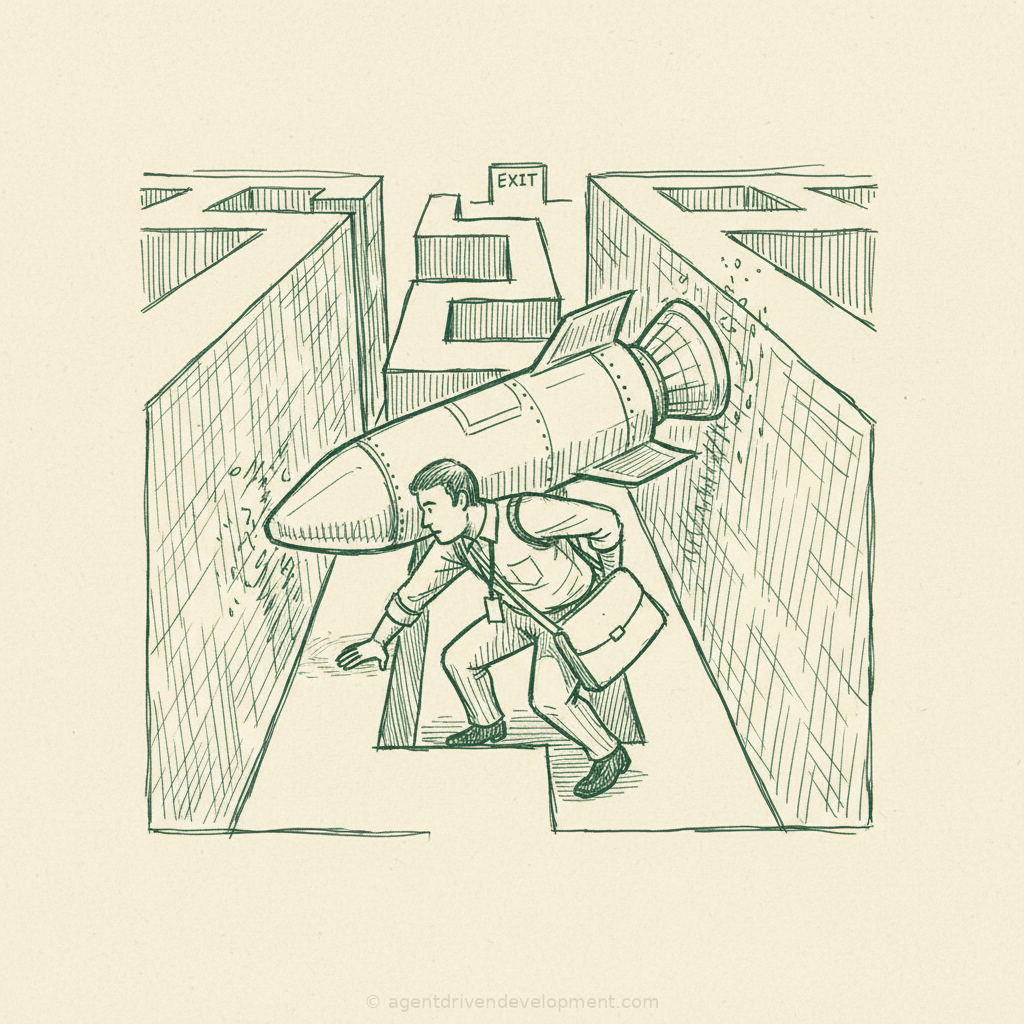
“I’m building a band of misfits who can actually ship. Because I can’t change the company. But maybe I can route around it.”
Removing the Risk
Sunday, 3:22 PM
Terry: Spent all day Friday with procurement and legal.
You: That sounds terrible.
Terry: Actually not. Got them to approve enterprise licenses for AI tools. Ran it through security review, got legal sign-off on acceptable use policy. Took four hours but now it’s officially sanctioned.
You: Why’d you do that?
Terry: Because everyone I found is using AI tools they’re paying for themselves. They’re all terrified someone’s going to find out and fire them for it. I needed to remove that risk.
You: Smart.
Terry: Now when I bring the band together, I can tell them: this is legal, it’s approved, you’re not going to get fired for using it. The only question is what we’re going to build with it.
The Band
Monday, 2:31 PM
Terry: Got the band together. Ten engineers.
You: How’d it go?
Terry: First thing I told them: I got procurement to buy the tools. Legal approved the use policy. Nobody’s getting fired for this. That changed the whole conversation.
You: They relaxed?
Terry: Yeah. They’ve all been doing this independently. All sitting on techniques that could save everyone else weeks. All terrified to talk about it publicly. But now they know it’s sanctioned, they opened up.
Terry: We’re going to eliminate test environment maintenance in two weeks. Something everyone hates. Something visible.
Two weeks later – Thursday, 11:47 PM
Terry: It works. Completely automated. Took 30 iterations on the prompt. We just stopped having test environment problems.
You: Did you announce it?
Terry: No. We just stopped having the problem. Took three days before another team asked us how we did it.
The Repository
Tuesday, 3:15 PM
Terry: Can you look at something for me?
Terry sent you the link to an internal GitHub repo. It was brutally honest:
- All 30 prompts they tried before finding one that worked
- Why the first approach failed
- The guardrails they built
- The things they still don’t trust AI to do
- Actual time investment (80 hours up front to save 240 hours per team per quarter)
“This is really good. It feels real.”
“That’s the point. I’m making it internal open source. Anyone can contribute. But you have to show me the production system you built with it. No theoretical examples.”
“One of the agile coaches asked if they should create a Community of Practice with regular ceremonies and a charter.”
“What’d you say?”
“I said no. The repo has more contributions in two months than their last Community of Practice generated in two years.”
The Wins Channel
Friday, 4:52 PM
Terry: Started a Slack channel. #shipped-with-ai. If you ship something with AI, you post what you shipped, how long it took, link to the PR, and one thing that surprised you.
You: No celebrations?
Terry: None. Just evidence.
Three weeks later
Terry: 300 people in the channel. Posts every single day. They’re getting competitive. Frontend engineer saw backend team eliminating API boilerplate. Asked if it would work for Redux actions. Two days later, she shipped it.
You: That’s viral.
Terry: Yeah. And I didn’t mandate any of it. The culture is changing and I’m not even trying to change it. Plus someone wrote a prompt for me to do my expenses.
The Constraint
Tuesday, 2:14 PM
Terry: Had a realization today. I can’t actually change the organization. Like, at all.
You: You’re just figuring this out now?
Terry: No, I knew it. But today I really internalized it. VP of Engineering built the entire process. CPO controls the roadmap with commitments from two years ago. General Counsel doesn’t trust AI and she’s not wrong – we’re in healthcare and finance. And someone the agile org owns changes, I just own ‘ai’.
Terry: I’m not trying to restructure the seven kingdoms. I’m building a network underneath them. Engineers who know how to eliminate toil within constraints.
You: Every three weeks, something undeniable ships?
Terry: Exactly. Last month we eliminated 300 hours of manual test maintenance. This month we automated architecture decision records. Next month, deployment pipeline config.
You: The board asking questions?
Terry: Not about headcount reduction anymore. They’re asking how to scale what we built.
The Win
Monday, 8:47 AM
Terry: You’re not going to believe this. The Stanford kids just lost their second customer.
You: What happened?
Terry: Production outage. Six hours. Their twelve engineers couldn’t debug it fast enough. They built everything with AI, and when it broke in a way the AI didn’t anticipate, nobody knew how to fix it.
Terry: Customer came back to us. Said they need a partner who can move fast but also knows how to keep the lights on. We closed it in three days. Migrated them in two weeks. No outage. No drama.
Six Months Later
Friday, 6:15 PM
You were finally getting that drink.
“So how does it feel?”
“Weird. The transformation they wanted would have taken five years. What I built is undeniable in six months.”
“What are the numbers?”
“Deployment frequency up 40%. Toil down 25%. We have 150 engineers actively using AI in production. We eliminated 1,200 hours of toil last quarter.”
“And you didn’t change the org chart.”
“Didn’t change anything structural. Just stopped doing work that doesn’t need doing. Shared what works. Built capabilities that compound.”
Terry took a long sip.
“Ten years from now, someone else sitting in my chair will inherit an organization that knows how to evolve. Not because we had perfect strategy. Because we figured out what actually worked and we wrote it down.”
“The Stanford kids are building the future.”
“Yeah. And we’re building the future that works when you have constraints. Both are necessary. But only one survives contact with enterprise reality.”
“That’s the bet you made.”
“That’s the job.”
Your phone buzzed. Another text from another Terry at another company asking if you had time to talk.
There are a lot of Terrys right now.
They’re all figuring out the same thing: you can’t transform faster than your organization’s immune system allows. But you can route around it. You can build networks underneath the org chart. You can make success contagious through evidence, not mandates.
The constraint is real.
But so is the opportunity.
The question is whether you’re willing to lead a transformation that doesn’t look like one.


