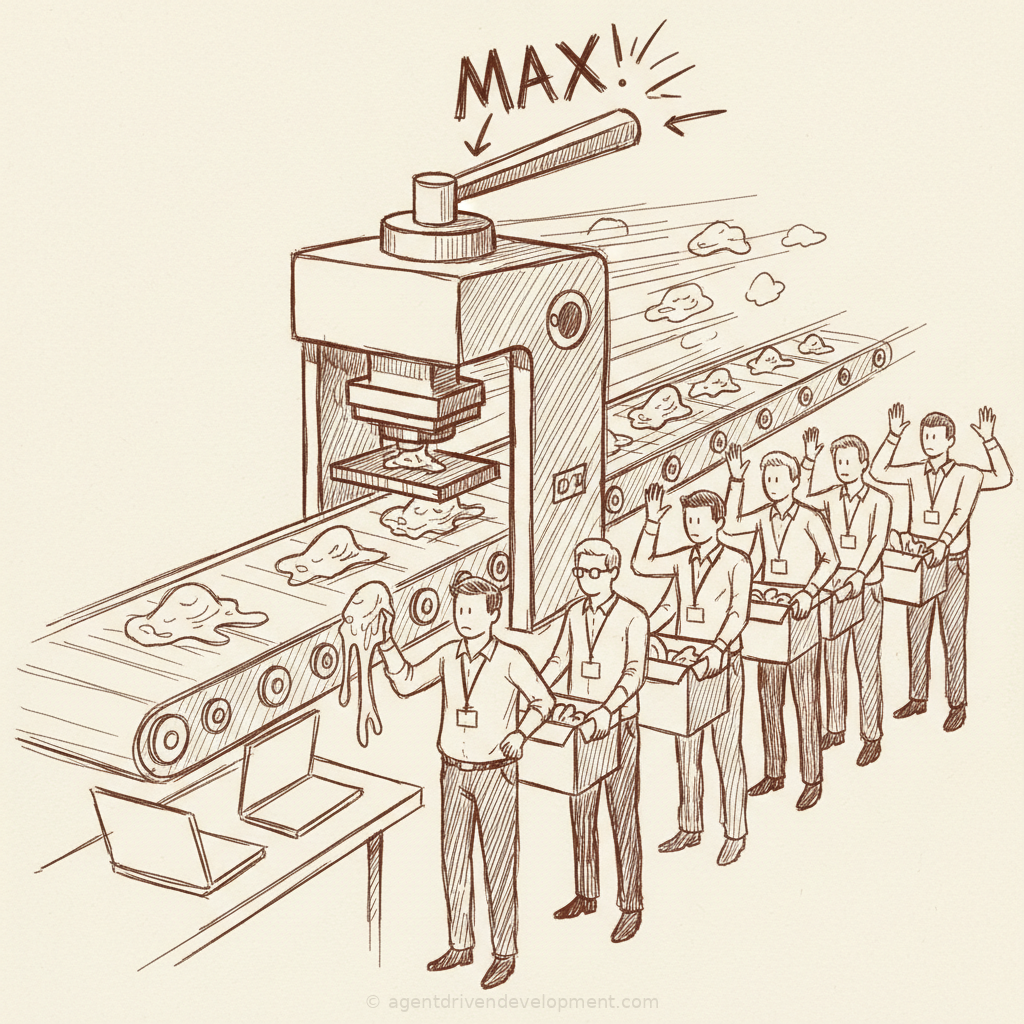
You Added AI. Congratulations, You Now Run a Slop Factory.
You gave your engineers AI tools and skipped the governance conversation. Now your PRs are tripling, your review queue is drowning, and nobody can tell the good code from the generated garbage. You did not adopt AI. You built a…
Capability is the only durable AI moat. Tooling is rented; capability compounds.
Redesign the SDLC with AI as a first-class participant.
AI accelerates the code generation phase, shifting bottlenecks to downstream processes like review, testing, and architectural validation. Treating the SDLC as a pipeline reveals new constraints.
Effective AI adoption requires intentional governance models that replace the inherent quality gates of human-paced development. This necessitates re-evaluating review allocation, architectural enforcement, and testing strategies.
Architectural coherence must be maintained by codifying constraints and domain boundaries into the AI agent's context, ensuring quality and conformity at the point of generation, not discovery.
Productivity in an AI-augmented environment is measured by validated, production-ready software shipped per unit of time with consistent quality, not by activity metrics like pull request count.
The most effective use of AI agents involves building clear, machine-readable constraints directly into their operational context, reducing the need for extensive human post-generation review and enabling smaller, highly effective teams.
The first question for any AI program: what does this organization measure, and what does the measurement reward?
Capability is the only durable AI moat. Tooling is rented; capability compounds.
Redesign the SDLC with AI as a first-class participant.
AI accelerates the code generation phase, shifting bottlenecks to downstream processes like review, testing, and architectural validation. Treating the SDLC as a pipeline reveals new constraints.
Effective AI adoption requires intentional governance models that replace the inherent quality gates of human-paced development. This necessitates re-evaluating review allocation, architectural enforcement, and testing strategies.
Architectural coherence must be maintained by codifying constraints and domain boundaries into the AI agent's context, ensuring quality and conformity at the point of generation, not discovery.
Productivity in an AI-augmented environment is measured by validated, production-ready software shipped per unit of time with consistent quality, not by activity metrics like pull request count.
The most effective use of AI agents involves building clear, machine-readable constraints directly into their operational context, reducing the need for extensive human post-generation review and enabling smaller, highly effective teams.
The first question for any AI program: what does this organization measure, and what does the measurement reward?
After 20 years in software development, Norman is both a hands-on leader and defining the new age of AI SDLC for some of the biggest brands in the world — and exploring it with the builders. He writes here about things he is hearing and seeing. All posts are his personal points of view and do not reflect any employer or any customer he has ever had contact with.
The views and opinions expressed in this article are the author’s own and do not represent the positions of any employer, client, or affiliated organization.