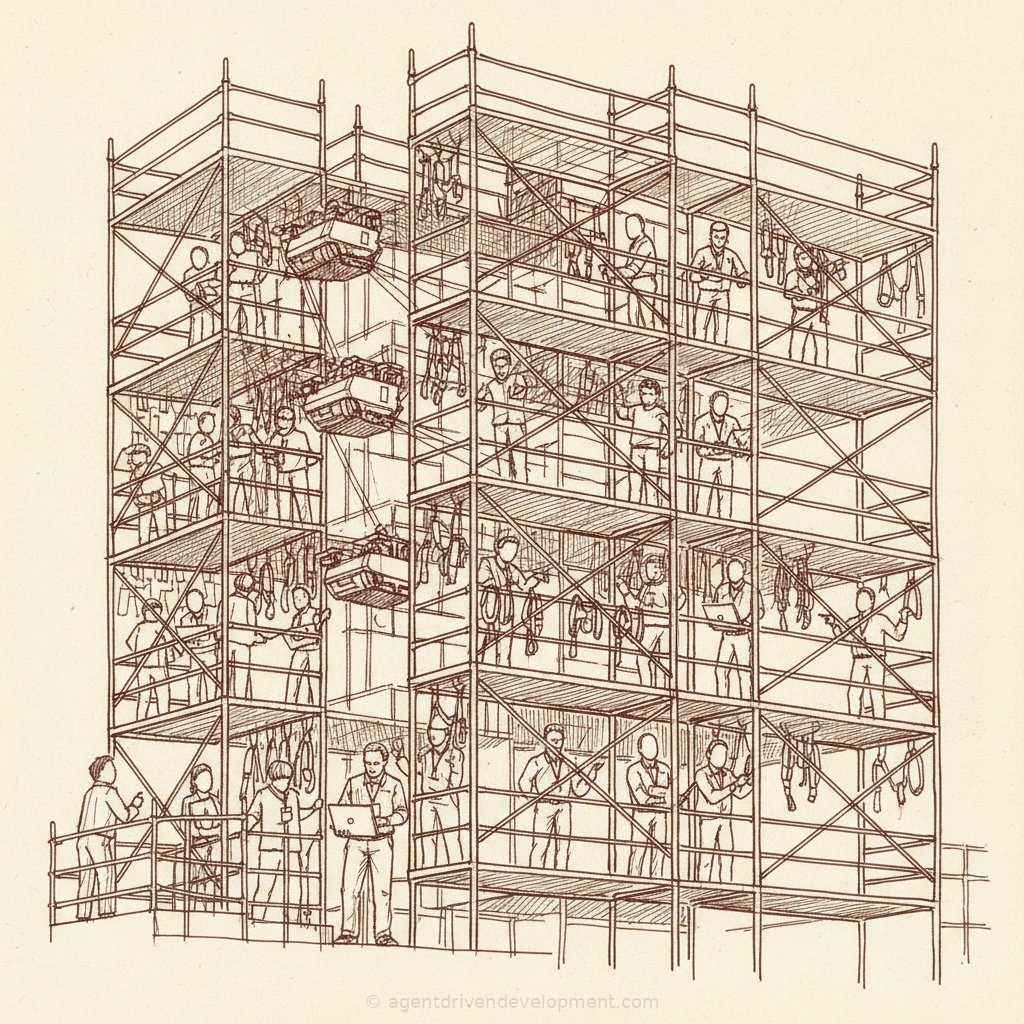
The introduction of AI agents into the software delivery lifecycle fundamentally alters the economic premise of traditional Agile artifacts. Organizations are optimizing for constraints that no longer exist.
Re-architect the SDLC for AI's true capabilities.
Agile artifacts mitigate human cognitive and social risks; they do not address AI's unique failure modes. Traditional constructs like user stories, story points, and separate QA phases are designed to manage human limitations, not specification incompleteness inherent in agentic development.
Agent-driven development shifts the primary bottleneck from implementation to specification completeness. Where humans err through misinterpretation, AI agents fail when specifications are ambiguous or incomplete, demanding precision at the input stage rather than iterative refinement post-development.
The economic justification for multi-layered work decomposition evaporates when agents handle comprehensive feature implementation. Hierarchies like epic-feature-story-subtask exist to manage human cognitive load and coordination overhead, which are nullified when an agent can execute a complete feature from a single, exhaustive specification.
Strategic learning velocity, not merely developer productivity, becomes the critical differentiator in an AI-augmented SDLC. Organizations optimized for rapid hypothesis testing via agent-driven specification and implementation cycles will out-innovate those constrained by legacy process artifacts.
The first question for any AI program: are you optimizing a legacy process or fundamentally redesigning the system for the new economic reality?
The introduction of AI agents into the software delivery lifecycle fundamentally alters the economic premise of traditional Agile artifacts. Organizations are optimizing for constraints that no longer exist.
Re-architect the SDLC for AI's true capabilities.
Agile artifacts mitigate human cognitive and social risks; they do not address AI's unique failure modes. Traditional constructs like user stories, story points, and separate QA phases are designed to manage human limitations, not specification incompleteness inherent in agentic development.
Agent-driven development shifts the primary bottleneck from implementation to specification completeness. Where humans err through misinterpretation, AI agents fail when specifications are ambiguous or incomplete, demanding precision at the input stage rather than iterative refinement post-development.
The economic justification for multi-layered work decomposition evaporates when agents handle comprehensive feature implementation. Hierarchies like epic-feature-story-subtask exist to manage human cognitive load and coordination overhead, which are nullified when an agent can execute a complete feature from a single, exhaustive specification.
Strategic learning velocity, not merely developer productivity, becomes the critical differentiator in an AI-augmented SDLC. Organizations optimized for rapid hypothesis testing via agent-driven specification and implementation cycles will out-innovate those constrained by legacy process artifacts.
The first question for any AI program: are you optimizing a legacy process or fundamentally redesigning the system for the new economic reality?
After 20 years in software development, Norman is both a hands-on leader and defining the new age of AI SDLC for some of the biggest brands in the world — and exploring it with the builders. He writes here about things he is hearing and seeing. All posts are his personal points of view and do not reflect any employer or any customer he has ever had contact with.
The views and opinions expressed in this article are the author’s own and do not represent the positions of any employer, client, or affiliated organization.