27 min read
Part One: The Text
The text from board chair Amanda arrived at 6:47 AM on a Tuesday: “We need to talk about the competitive situation.”
David sat in his kitchen and felt his stomach drop. Four years as CEO of Velocity Systems. Grew it from $80M to $200M ARR. Built what he thought was a solid engineering organization.
And now three Stanford dropouts had taken 10% of his market in eight months.
The startup,Cascade,was on the front page of Hacker News. Series B announcement. $50M valuation. Three people working from their grandmother’s pool house, building everything in public.
Top comment, 2,847 upvotes: “No office, no QA team, no legal review board, no security approval process. Just engineers shipping with AI agents. This is what the future looks like.”
David had just approved $300K for the quarterly engineering offsite in Napa. Wine country. Team building. Trust falls.
Cascade shipped features in three weeks that took his 200-person team four months.
He opened Cascade’s engineering blog,they documented everything publicly. Their workflow: Engineers write code with AI agents. AI generates comprehensive tests in seconds. AI scans for security vulnerabilities. AI checks compliance patterns. Engineer reviews everything. Ship to production.
Total time: Three weeks. No handoffs. No queues. No approval chains.
Then he did something that made him both laugh and feel sick. He opened TikTok. His intern had sent him a link yesterday: “Um… is this what our PMs actually do all day?”
The video was titled “Velocity Systems: A Day in the Life of a Product Manager.”
9:00 AM – Standup meeting
10:00 AM – Sync with legal about feature compliance
11:00 AM – Security review kickoff meeting
12:00 PM – Lunch
1:00 PM – QA prioritization meeting
2:00 PM – Cross-functional stakeholder alignment
3:00 PM – Roadmap review with leadership
4:00 PM – Documentation updates
5:00 PM – Email catch-up
Zero minutes writing specifications. Zero minutes talking to customers. Zero minutes making decisions. Zero minutes shipping anything.
3.2 million views. Top comment: “POV: You make $180K to attend meetings about meetings.”
David stared at his phone. Amanda’s text blinked at him.
He typed back: “I know. And I know what needs to happen. Give me the board meeting to prove I can do it.”
Three minutes later: “You have six days. Make them count.”
Part Two: The Archaeology
David didn’t call an executive meeting. Not yet. First, he needed to understand where time actually died.
He called his CFO, Lisa. “I need something from you today. Last year we spent $50 million on product development. I need to know what we actually got for it. Real costs per feature. Which ones drove revenue. Which ones customers use.”
Silence on the line.
“Lisa?”
“David, we don’t track it that way. Engineers work on multiple features simultaneously. They don’t log time consistently. I can give you ranges, but precise allocation is,”
“What kind of ranges?”
“For a typical feature? Between $620K and $1.4M, depending on how we allocate shared resources.”
David felt something cold settle in his chest. “That’s a $780,000 range.”
“Yes.”
“Lisa, that changes today. I need a plan on my desk by end of day showing how we get to 20% accuracy within 60 days.”
He pulled a random feature from last quarter’s shipments. “Customer Dashboard 2.0.” Supposedly completed three months ago. He started making calls.
His first call was to Sarah, his best senior engineer.
“Sarah, quick question. How long did Dashboard 2.0 actually take to build?”
“The actual coding? Maybe three weeks if I’d been able to work on it straight through.”
“But it took four months calendar time. Where did the rest go?”
Sarah laughed without humor. “Oh boy. Week one, Tom’s product team spent six straight days debating whether the settings panel should be a modal or a sidebar. Six days. Week two, I finally got specs and started coding. Then legal review came back needing GDPR compliance. Eight days waiting just to get on their calendar,”
“Wait. Eight days waiting?”
“That’s actually fast for legal. Week three, security review. They were backed up six weeks, so I context-switched to three other features. Week four, back to Dashboard when security opened up, but requirements had changed because legal wanted different consent flows,”
“Keep going.”
“Week six, pushed to QA. Eight-day queue. Week seven, came back with four bugs. But David, I wrote that code nine days ago. Context was completely gone. I spent three hours just remembering what I’d been thinking. Week eight, fixed bugs, back to QA. Week nine, security finally finished and wanted architectural changes. Week ten, legal wanted to review again because security changes affected the consent model,”
“Sarah, stop. Three weeks of coding took seventeen weeks because of handoffs?”
“Yes. And that’s normal now. Every handoff joins a queue. Every queue is a week minimum, usually more. By the time work comes back, we’ve forgotten what we were doing.”
David thanked her and sat in silence.
Then he opened the organizational chart he’d built so carefully over four years.
VP of Product (Tom)
VP of QA (Robert)
VP of Security (Richard)
VP of Legal (Jennifer)
VP of Architecture (Patricia)
VP of Engineering (Michael)
VP of Agile Transformation (Melissa)
Seven VPs. Seven separate kingdoms. Every boundary created a handoff. Every handoff created a queue. Every queue added a week or more.
His eyes stopped on one box: VP of Agile Transformation.
Melissa and her team of twelve agile coaches. Their entire job was helping teams adopt agile practices. Run better retrospectives. Optimize ceremonies. Improve sprint velocity metrics.
They’d been doing this for three years.
He called Melissa. “Tell me what your coaching team does on a typical week.”
Melissa launched enthusiastically. “We facilitate sprint planning sessions, coach teams through retrospectives, optimize standups, train on story point estimation, coach product owners on backlog refinement, help teams understand velocity trends,”
“Melissa, stop. How much time does your team spend actually helping engineering ship features faster?”
“That’s what all those activities do! When teams have better ceremonies and understand their velocity,”
“How much time do you spend identifying organizational bottlenecks and eliminating them?”
Pause. “Well, that’s more of a leadership team responsibility. We focus on team-level,”
“How much time reducing wait times between different departments?”
Longer pause. “David, that’s not really what agile coaching addresses. We focus on individual team practices,”
David felt something click. “Let me get this straight. We have twelve people dedicated to making teams more agile. We’ve had them for three years. Sprint velocity metrics are up 23%. And yet our cycle time has gone from sixteen weeks three years ago to seventeen weeks today. We’re actually slower.”
Silence.
“Meanwhile, Cascade has 3 people in a pool house, zero agile coaches, and ships in three weeks. So I’m genuinely asking: We have an entire organization for agile transformation, and this is it? We’re slower than before you started?”
Melissa’s voice got defensive. “The teams are executing much better at the team level. Their ceremonies are cleaner, their retrospectives more productive,”
“But the organization is slower. Because you’re optimizing team practices while ignoring the seven-week queues between organizational silos. You’re making standups efficient while features wait in queues for 53% of their lifecycle.”
“That’s not,”
“Thank you, Melissa.”
David hung up and stared at his org chart. Seven VPs. Twelve agile coaches. Millions in overhead.
Cascade had 3 people and shipped five times faster.
Part Three: The Mixed Results
David needed one more piece before the meeting. He called Michael, his VP of Engineering.
“Michael, tell me the truth about our AI coding initiative. Where are we really?”
Michael sighed. “We’re finishing month three of the proof of concept. Ten engineers testing various AI agent frameworks,”
“And?”
“Mixed results.” Michael’s voice carried resignation. “Some engineers swear by it. Some barely use it. Productivity metrics are inconclusive. Some features shipped faster, others didn’t. Code quality is all over the place. We’re planning to extend the POC another quarter, gather more data, run A/B tests, try different vendors,”
“Michael, stop. Can I ask you something directly?”
“Of course.”
“Are we running this POC to figure out if AI works, or to delay the decision to deploy it?”
Long, painful silence.
“Probably… both? Look, there’s real uncertainty. We don’t know which vendor to standardize on. We don’t know if code quality holds up. We don’t know if security will approve it. We don’t know if legal will have licensing concerns,”
“So we’re running a three-month pilot to figure out what we don’t know, then another three months to address concerns, then another to pick vendors, and meanwhile Cascade is using AI agents in production and shipping five times faster.”
“When you put it that way,”
“Michael, Cascade’s engineers use AI to write code, generate tests, scan security, check compliance. They don’t run three-month pilots with mixed results. They don’t spend quarters picking vendors. They use whatever works and ship. That’s why they’re taking our market.”
“You’re saying we should just deploy it? To everyone?”
“I’m saying we need to stop studying AI and start being AI-native. But first, we need to eliminate the handoffs that make everything take months instead of days. Because even with AI tools, they’d still wait eight days for QA and six weeks for security.”
Michael was quiet.
“Meeting tomorrow, 8 AM. Bring data on where time actually goes. Everyone needs to see what I’m seeing.”
Part Four: The Meeting
Wednesday morning, 8:00 AM sharp. Seven VPs sat around the conference table. David had printed detailed packets for each of them.
“We’re going to do something different this morning. I’m going to show you where time actually disappears in this organization. Then I’m going to ask you one question. Only one.”
He opened to the first page. A Gantt chart that would make any project manager weep.
“Last quarter we shipped twelve features. Let me show you where the time went on just one. Customer Dashboard 2.0.”
Feature: Customer Dashboard 2.0
Engineering time (actual coding): 3 weeks
Product specification debates: 6 days
Legal review #1: 8 days waiting + 2 days review
Security review: 6 weeks waiting + 3 days review
Legal review #2: 11 days waiting + 1 day review
QA queue: 8 days waiting + 2 days testing
Bug fixes (with lost context): 4 days
Architecture review board: 9 days (2 weeks waiting + 2 days review)
Stakeholder approvals: 7 days
Total calendar time: 17 weeks
Actual value-creating work: 5 weeks
Waiting in queues: 9 weeks
Rework due to late feedback: 3 weeks
Number of handoffs: 8
“This pattern repeats across all twelve features. On average: 30% actual work. 53% waiting in queues. 17% rework because feedback came so late people forgot what they were doing. Every handoff adds a week minimum. Usually more.”
He flipped to the next page. Cascade’s process for an equivalent feature, pulled from their public blog.
Cascade’s process:
Engineer writes code with AI agents: 3 weeks
AI generates comprehensive test suite: 30 seconds
AI runs security vulnerability scans: 2 minutes
AI checks compliance patterns: 5 minutes
Engineer reviews all AI outputs: 1 hour
Deploy to production: Immediately
Total time: 3 weeks
Number of handoffs: Zero
“They ship in three weeks what takes us seventeen. Not because their engineers are smarter. Because they have zero handoffs. No queues. No context switching. No waiting.”
Richard, VP of Security, leaned forward. “You cannot do adequate security review in two minutes. That’s reckless.”
David pulled out his phone and loaded Cascade’s technical blog. “They use AI agents to scan for OWASP Top 10 vulnerabilities, check authentication patterns, analyze data flows, verify encryption standards, flag injection risks, validate authorization logic. The AI never sleeps. Never has a backlog. Then a human reviews the findings in an hour. Their security audit showed they catch more issues than traditional review processes.”
Jennifer, VP of Legal, shook her head. “Legal compliance cannot be automated. The nuances require human judgment.”
“You’re right that judgment requires humans. But they’re not automating judgment,they’re automating the checking. AI scans for GDPR patterns, CCPA compliance, data retention policies, consent flows, cross-border transfer risks. Flags anything questionable. Then their general counsel reviews the flags in an hour. Compare that to our three-week queue where legal is pattern-matching 90% of the time anyway.”
Patricia, VP of Architecture, crossed her arms. “Architecture review requires careful consideration of long-term implications. You can’t rush that.”
“Your board meets twice a month. Features wait two weeks just to get a meeting slot, then another week for review. Most feedback is about coding patterns that could be automatically enforced. Cascade uses AI to enforce architecture patterns at commit time. Violations get flagged immediately. If there’s a genuine architectural decision, engineers discuss it in real-time, not two weeks later after the context is dead.”
Tom, VP of Product, looked uncomfortable. “What about product decisions? You can’t automate strategy.”
“No.” David pulled up the TikTok on the screen. “But I watched something yesterday I can’t stop thinking about. ‘Day in the life of a product manager.’”
He played it. Nine hours of meetings. Coordination. Alignment. Handoff management. Zero product work.
“3.2 million views. Top comment: ‘You make $180K to attend meetings about meetings.’ I forwarded this to our team as a joke. Nobody laughed. Because it’s not a joke. It’s a documentary. Our product managers have become coordinators who shepherd features through seven different approval chains. They spend half their time managing handoffs instead of doing product work.”
Tom’s face went red.
David turned to Melissa. “Melissa, you run our agile coaching organization. Twelve people. Three years. You’ve been optimizing ceremonies, improving retrospectives, refining story points. Can you tell the group: how has our cycle time changed in those three years?”
Melissa shifted. “Our velocity metrics have improved significantly. Teams are up 23% in story point completion,”
“I didn’t ask about story points. I asked about cycle time. How long does it take to ship a feature now versus three years ago?”
Pause. “I’d need to pull the specific data,”
“I’ll tell you. Three years ago, sixteen weeks. Today, seventeen weeks. We’re slower. We have twelve agile coaches optimizing team practices, and we ship slower than before you started.”
David let that sink in.
“Cascade has 3 people. Zero agile coaches. Ships in three weeks. So I’m genuinely puzzled: We have an entire organization dedicated to agile transformation. And this is it? We’re slower with more handoffs, longer queues, more coordination overhead?”
Melissa looked at her hands. “The teams are executing better at the team level. Their ceremonies are more effective,”
“But the organization is slower. Because your coaching focuses on team practices while completely ignoring organizational handoffs. You’re optimizing fifteen-minute standups while features spend nine weeks waiting in queues. You’re teaching teams to estimate story points while 53% of our time is spent waiting for handoffs between silos.”
The room was silent.
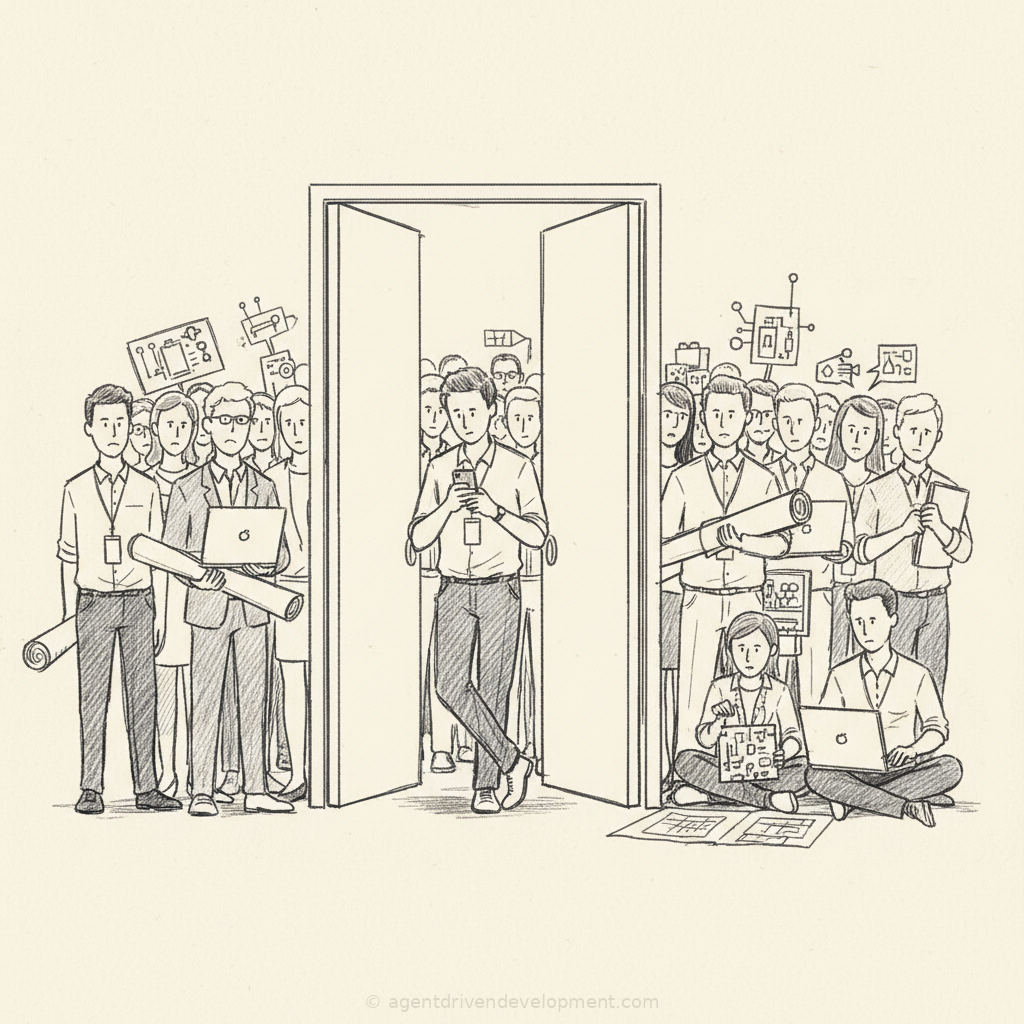
David leaned forward. “Here’s the pattern. We’ve built seven separate organizations. Seven kingdoms. Every boundary creates a handoff. Every handoff becomes a queue. Every queue adds wait time. We spend 53% of our time,more than half,just waiting.
“Cascade doesn’t have seven organizations. They have engineers who own features end-to-end. They use AI agents to do instantly what our seven organizations do manually over seventeen weeks. No handoffs. No queues. No wait time.
“So here’s my question. The only question I’m asking today.”
He looked at each VP in turn.
“Can you eliminate your queues in 90 days? Can you remove the handoffs? Because if you can’t, I’m going to eliminate your organizational boundaries to eliminate the handoffs for you.”
The silence was profound.
Michael, VP of Engineering, spoke first. “I can eliminate the architecture review board as a separate gate. We move those checks into development using AI to enforce patterns automatically. Engineers review each other’s architecture in real-time instead of waiting two weeks for a meeting. No handoff. No queue. I’m in.”
Richard, VP of Security, looked like he was struggling. “Security review is absolutely critical. I can’t just,”
“Richard, I’m not asking you to eliminate security review. I’m asking you to eliminate the handoff and the six-week queue. Can your team train engineers to run AI security scans themselves? Can you focus on reviewing flagged exceptions instead of manually reviewing everything? Can we go from six weeks of waiting to same-day validation?”
“That would require trusting engineers to run the scans and interpret results,”
“Richard, yes or no. Can you eliminate the handoff and queue in 90 days?”
Very long pause. “Yes. But my team will need to train engineers on the tools.”
“You’ll have whatever you need. Jennifer?”
The VP of Legal looked at her notes. “Most of our review is pattern-matching. Checking GDPR compliance, data retention, consent flows. If AI can catch 90% of standard patterns and flag exceptions, we can review just the flags. Engineers run compliance checks themselves, we review exceptions in hours instead of weeks. I’m in.”
“Tom?”
Tom looked around the table. Then something shifted in his expression. “My product managers spend half their time coordinating handoffs between all these organizations. If the handoffs go away…” He paused. “They can actually do product work. Write specs. Talk to customers. Make decisions. Build things themselves with AI even. Yes. I’m in.” He smiled slightly. “I’m just realizing… if we eliminate all these handoffs and my PMs can do actual product work instead of coordination… that’s transformative. Yes. Definitely in. But David, I need help. I need people who know how to work this way,people who’ve operated AI-native.”
David nodded. “We’ll come back to that. Robert?”
The VP of QA stared at David. “You want me to eliminate the QA organization.”
“I want you to eliminate the eight-day handoff. Cascade doesn’t have a separate QA team. Engineers own quality end-to-end using AI agents to generate comprehensive test suites. Their quality metrics are better than ours. Can you help engineers own quality themselves using AI instead of maintaining a handoff to a separate organization?”
“That’s not a queue reduction. That’s eliminating my entire function.”
“Robert, I’m asking: can your team help engineers own quality directly using AI, or do you want to keep running an eight-day handoff that produces measurably worse quality than engineers using AI themselves?”
Robert stood abruptly. “This is insane. You’re eliminating quality assurance based on what some startup writes in a blog post? This is reckless.”
“I’m talking about eliminating a handoff that creates an eight-day queue while producing worse outcomes. Your team members can join engineering teams to help them adopt AI-driven quality practices, or they can leave. But the handoff ends in 90 days.”
Robert looked around for support. No one met his eyes.
“Then I’m out. I won’t be part of this disaster.” He walked out.
David watched him go, then turned to Melissa. “Melissa, same question. Can your agile coaching team help us eliminate organizational handoffs, or are you optimizing team practices while the organizational structure stays broken?”
Melissa spoke quietly. “That’s not what our coaching does. We focus on scrum practices, ceremonies, team dynamics. What you’re describing is organizational design and structural change. That’s not in our,”
“So you can’t help us eliminate the handoffs that create 53% of our wait time?”
“Not really, no.”
“Then I don’t need an agile coaching organization. I need the organizational structure fixed. You can stay and help with that transition, or you can find a company that wants team-level optimization while their structure remains broken. Your choice.”
Melissa stood. She looked sad, not angry. “I think this isn’t the role I signed up for. I’m out too.”
She walked out quietly.
David looked at the remaining five VPs. “We’re going from seven VPs to five. From eight handoffs per feature to zero. From seventeen-week cycle time to three weeks. We’re ending the AI pilot and deploying AI agents company-wide next week,not as an experiment, but as standard practice. We’re not picking vendors first. Engineers use whatever works, we’ll consolidate later if needed.
“Michael, here’s what I need from you: Go hire four principal engineers. I don’t care if it’s $250K each. Remote or local doesn’t matter. I need AI-native engineers,people who’ve actually built with AI agents in production, not people who’ve run pilots. People who’ve lived this way and can help others learn.
“In fact, I’m calling HR after this meeting and telling them to ignore the prevailing wage requirements for these roles. We’re hiring for capability and speed, not compensation bands. And Tom, in 60 days I’m asking the board for approval for eight more in product. We’re building an AI-native core that will transform the organization.”
Michael nodded, energized. “Four principal engineers. AI-native. I’ll start recruiting today.”
“Michael, you also own the transformation. Weekly updates to me. Patricia, your architecture team becomes engineers again who review in real-time. Richard, your security team trains engineers and reviews exceptions. Jennifer, your legal team does the same. Questions?”
Patricia raised her hand. “My entire team exists to run architecture review. What happens to them if we eliminate the review board?”
“They become engineers again. They review architecture in real-time during development instead of in formal meetings. Some will love it,they’ll be building again instead of attending meetings. Some won’t and will leave. That’s fine. We’re competing with Cascade, and Cascade doesn’t have an architecture review board. You will also lead the QA capability by empowering the engineering teams.”
“And the agile coaches?”
“Three of Melissa’s team can stay and help with organizational transformation,eliminating handoffs, redesigning workflows, training on AI tools. The rest will need to find roles elsewhere. We don’t need team-level practice coaching when we’re fixing the structure.”
David paused. “One more thing. Next quarter we have $300K budgeted for the Napa offsite. Trust falls and personality assessments and wine tasting. I’m canceling it. That’s four more principal engineers right there. Nobody pushes back when I drop $300K on trust falls in wine country, but I guarantee someone will question spending that on talent that will actually transform this organization. Well, I don’t care about the pushback. We’re hiring the talent.”
Nods around the table.
“This meeting is over. We have work to do.”
Part Five: The Board Meeting
Monday morning. David walked into the boardroom with Michael. Michael carried a laptop and looked nervous but determined.
Amanda sat at the head. Five board members. They looked serious. They’d clearly been talking before David arrived.
David didn’t wait for questions.
“Before you ask whether I’m the right CEO to compete with Cascade, let me show you what happened in the last five days.”
He projected slides.
“On Wednesday, I showed my executive team where time dies in our organization. 30% actual work. 53% waiting in queues created by handoffs. 17% rework because feedback comes so late people forget what they were doing.
“I asked each VP one question: Can you eliminate your handoffs and queues in 90 days?
“Robert, our VP of QA, said no. He refused to eliminate the eight-day handoff. He left.
“Melissa, our VP of Agile Transformation, also said no. Her team optimizes team practices while ignoring organizational handoffs that create 53% of our wait time. She left too.
“Everyone else said yes.”
Amanda raised an eyebrow. “You lost two VPs in one meeting?”
“I eliminated two organizational boundaries creating handoffs. Robert’s QA team is joining engineering teams this week to help them own quality directly using AI. No more handoff. No more eight-day queue. Melissa’s agile coaches,three are staying to help eliminate organizational bottlenecks and report to Michael. Nine are leaving because we don’t need team-level practice coaching when the structure itself is the problem.”
“That’s… aggressive.”
“It’s necessary. We also ended our three-month AI proof of concept immediately. We had mixed results because we were treating AI like an experiment instead of infrastructure. We were trying to pick perfect vendors while competitors were shipping. Starting this week, we’re deploying AI agents company-wide,not as a pilot, but as standard practice. Engineers use tools Sarah helps select, and we’ll handle vendor consolidation later if it matters.”
Board member Richard leaned forward. “That seems extremely risky. What if code quality suffers?”
“What if it doesn’t? Cascade uses AI for everything and ships in three weeks with measurably better quality than our seventeen-week process. They proved this works. We’re copying them.”
Michael spoke up. “Here’s what we’re eliminating in 90 days. Security handoff,engineers will run AI security scans, security reviews only flagged exceptions. Legal handoff,engineers run AI compliance checks, legal reviews only flags. Architecture handoff,AI enforces patterns at commit time, no more review board meetings. QA handoff,engineers own quality using AI-generated tests, former QA engineers coach them. Result: Zero handoffs. Zero queues.”
David continued. “Every handoff we eliminate removes a week or more of wait time. Eight handoffs becomes zero. Seventeen weeks becomes three weeks.
“We’re also investing in talent immediately. I authorized Michael to hire four principal engineers at $250K each. AI-native engineers who’ve actually shipped with AI agents in production. Not people who’ve run pilots,people who’ve lived this way. They’ll transform the organization from inside. And I’m coming back in 60 days to ask for approval for eight more.”
He paused. “I also canceled next quarter’s $300K offsite in Napa. Trust falls and wine tasting. Nobody ever questioned that budget. But I guarantee I’ll get pushback on spending that money to hire talent that will actually save this company. Well, I don’t care about the pushback. We’re hiring the talent.”
Board member Patricia looked concerned. “That’s a million dollars immediately and another two million in 60 days. Three million in senior engineering talent. That’s significant.”
“It’s a million now and two million more in 60 days if you approve. But Cascade took 10% of our market in eight months with 3 people. If we don’t become AI-native fast, we’ll lose another 20% in the next year. Three million in talent is cheap compared to losing 30% market share. And it’s less than we spend annually on offsites that don’t move the needle.”
Amanda looked at the other board members, reading the room. Then back at David. “You’re asking for pre-approval on the additional eight hires?”
“I’m telling you I’m going to ask in 60 days. I want you to know now so you can see the first four in action and understand why we need the next eight.”
Board member Richard asked: “What about all the people in the organizations you’re eliminating? That’s a lot of disruption.”
“Architecture team becomes engineers again,they’ll love it or leave. Security team focuses on exception review,they’ll do more meaningful work. Legal team does the same. QA team joins engineering as quality coaches,most are excited. Agile coaches,three stay for organizational transformation, nine leave. Total immediate headcount reduction: two VPs who chose to leave, nine coaches who don’t fit. Everyone else transitions to higher-value work. We’re adding four principals. Net impact: smaller, faster, more capable organization.”
Amanda looked at Michael. “You believe this works?”
Michael nodded. “We’re doing exactly what Cascade does. They documented their entire process publicly. The AI tools exist and work,we’ve been running pilots that prove it. We just need to deploy them and eliminate the handoffs. The four principals David authorized? I’ve already got calls scheduled with three candidates today. They’re people who’ve been waiting for companies to get serious about AI-native development instead of just talking about it.”
Amanda looked at the other board members. Subtle nods around the table.
“David, three months ago we weren’t sure you were the right CEO for this moment. Today, you’re showing us exactly the decisive leadership we needed to see. You have 90 days. Show us this works.”
She paused. “And we’ll discuss the additional eight principals in 60 days. Show us the first four were worth it.”
“You’ll have data, not promises.”
Part Six: 90 Days
David walked into the second board meeting with Michael, Sarah (whom he’d promoted to Principal Engineer), and two of the new AI-native principals,James and Keisha.
Sarah projected the results without preamble:
Before:
-
Cycle time: 17 weeks average
-
Time in queues: 53%
-
Handoffs per feature: 8
-
Features shipped per quarter: 12
-
Production incidents: 2.3 per feature per month
-
Cost per feature: Unknown within 20%
After (90 days):
-
Cycle time: 3.4 weeks average (80% faster)
-
Time in queues: 4%
-
Handoffs per feature: 0
-
Features shipped per quarter: 24 (100% increase)
-
Production incidents: 0.5 per feature per month (78% reduction)
-
Cost per feature: Known within 12%
What happened to each handoff:
QA Handoff (8-day queue): Eliminated completely. Engineers own quality using AI-generated tests. Former QA team embedded as quality coaches. Result: Better quality, zero wait time.
Security Handoff (6-week queue): Eliminated. Engineers run AI security scans. Security reviews only flagged exceptions. Average time: 4 hours instead of 6 weeks. More issues caught, 99% faster.
Legal Handoff (3-week queue): Eliminated. Engineers run AI compliance checks. Legal reviews only flags. Average time: 3 hours instead of 3 weeks. Better compliance, 95% faster.
Architecture Handoff (2-week queue): Eliminated. AI enforces patterns at commit. Engineers review each other’s designs during development. Better architecture, zero wait time.
James, one of the new principals, spoke. “Before Velocity, I was at a startup where everyone used AI agents from day one. No handoffs, no queues, just engineers shipping. When David hired me, I thought I’d spend months convincing people this could work. Instead, he’d already eliminated the handoffs. My job was just showing people how to use the tools effectively. It’s been the smoothest transformation I’ve ever seen because the org structure supported it instead of fighting it.”
Keisha added. “The difference is dramatic. At my last company, we ran AI pilots for six months trying to pick the perfect vendor. Here, David said use whatever works. Some engineers prefer one framework, others use different ones. Doesn’t matter. What matters is they’re shipping fast and the handoffs are gone. We’re not debating tools,we’re using them.”
Then David smiled. “And here’s something we didn’t expect. One of Tom’s product managers, Alex, got so excited about working without handoffs that he spent a weekend building something with AI agents. A whole new product feature,customer sentiment analysis dashboard that integrates with our main platform. Built it soup to nuts in 48 hours. Customers saw the demo and three wanted to beta test immediately.”
Amanda’s eyes widened. “A product manager built a new product in a weekend?”
“That’s what happens when you eliminate handoffs and give people AI tools. Alex wasn’t spending his time coordinating seven approval chains. He had time and energy to actually build. We’re commercializing what he built. Hiring two more engineers to scale it. So our net headcount isn’t down,it’s actually up. Lost two VPs and nine agile coaches, added four principals, now adding two engineers for Alex’s new product. Net: up four.”
Board member Richard sat back. “A product manager shipped a product in a weekend that you’re commercializing. That’s remarkable.”
“That’s what AI-native organizations can do. That’s what we’re becoming.”
Amanda stared at the numbers. “You eliminated four organizational boundaries and every single metric improved. And you’re commercializing a product a PM built in a weekend?”
David nodded. “We didn’t eliminate the work. We eliminated the handoffs. Security still happens,engineers just run AI scans instead of waiting six weeks. Legal review still happens,engineers just run checks instead of waiting three weeks. Architecture review still happens,it’s just continuous during development instead of a gate. Quality assurance still happens,it’s just built in by engineers using AI instead of inspected afterward by a separate team.
“And when you remove the handoffs, amazing things happen. People have energy again. They build things on weekends because they actually can. That’s what we’ve unlocked.”
Board member Patricia asked. “What actually happened to all those people? That’s real human impact.”
Michael answered. “Former QA team: joined engineering teams as quality coaches. Most are thriving,they’re teaching instead of gatekeeping. Two left to find traditional QA roles elsewhere. Former architecture review board: became engineers again. Most love being hands-on. Three left for architecture jobs elsewhere. Security team: 20% reduction through voluntary attrition, remaining team much happier because they focus on complex threats instead of routine reviews. Legal team: same headcount, significantly less stressed because they review exceptions instead of everything. Agile coaches: three stayed and helped with transformation, nine left for team-coaching roles elsewhere.
“And we hired four principals plus two engineers for Alex’s new product. Total headcount: down 15 through attrition and departures, up 6 with new hires. Net: down 9 people. But we’re adding 2 more for the sentiment analysis product. So net: down 7, essentially flat when you account for natural attrition.”
David corrected. “Actually, Michael, we’re net up four from where we were when I started. Down 15, up 6 principals and engineers, plus we’re adding 2 more for Alex’s product, that’s up 8. Net up 4. And we’re shipping 100% more features.”
Sarah added. “That TikTok video about product managers attending meetings all day? That’s gone. Tom’s product managers do product work now. They write specs that AI can work with. They talk to customers. They make decisions. They build things on weekends because they have energy and tools. The transformation in morale is remarkable.”
David leaned forward. “The four principal engineers have been worth every dollar. They’ve trained 40 engineers in 90 days on AI-native workflows. Those 40 engineers now ship three times faster. Which is why I’m here to ask for the eight additional principals we discussed.
“Same model: $250K each, remote or local doesn’t matter, AI-native engineers who can transform the next wave. With twelve total principals, each working with 15-20 engineers, we can have the entire engineering organization operating AI-native within six months.”
Board member Richard asked. “That’s another $2 million. Three million total in principal engineers. How do we know the next eight will have the same impact as the first four?”
Michael responded. “The first four trained 40 engineers. Those 40 ship three times faster. If the next eight train 120 more engineers at the same rate, we’re talking about tripling output for 160 engineers,80% of our engineering team. Three million in salary to potentially triple engineering output across most of the organization. The ROI is clear.”
Amanda looked at the other board members. “This is exactly what we hoped to see. The metrics are undeniable. The first four principals clearly accelerated the transformation.” She looked around the table. “All in favor of approving eight additional principal engineer hires at $250K each?”
Five hands went up immediately.
“Approved. Three million total investment in AI-native talent. David, keep doing exactly what you’re doing.”
Part Seven: Day 180
After another board meeting, Amanda and Richard stayed behind. Their expressions had changed from formal to conspiratorial.
“David, question for you,” Amanda began. “How would you feel about doing this again? At much bigger scale?”
David tilted his head. “What do you mean?”
Richard spoke. “I’m on the board of Titan Industries. $2 billion in revenue. 3,000 employees. They’re getting destroyed by AI-first competitors across three different product lines. The organizational dysfunction makes Velocity look streamlined.”
“How bad?”
“Seven separate QA organizations across different business units. Four security review boards with overlapping jurisdictions. Three legal compliance teams. A PMO with 65 people whose entire job is coordinating handoffs. An architecture governance council that meets monthly. Features that should take six weeks take eighteen months.”
Amanda smiled. “Their CEO is retiring in six months. They need someone who’s actually eliminated organizational boundaries and handoffs at scale. Not someone who talks about it. Someone who’s done it.”
David felt his pulse quicken. “Titan? That’s…”
“Five times bigger than Velocity with twenty times more handoffs,” Amanda finished. “But you just proved the model works. You eliminated handoffs, kept people, and improved every metric. You built an AI-native organization in 90 days. They need someone who can do that at scale.”
“You’re asking me to leave Velocity?”
“We’re asking you to consider an opportunity. Michael can run Velocity. He led this transformation with you. He understands how to eliminate handoffs and build AI-native teams. We’d promote him to CEO, Sarah backfills his role, and you’d stay on our board.
“But Titan needs what you just did here. And they need it urgently.”
Richard pulled out his phone and showed David a Hacker News thread from two days ago. A startup called Apex had raised $75M Series C. Top comment with 4,000 upvotes: “Titan is dead and doesn’t know it yet. Apex ships in weeks what takes Titan years. Zero organizational handoffs, just engineers with AI agents shipping features. Classic disruption pattern.”
David smiled grimly. “I’ve seen this movie before.”
“Will you take the meeting?”
David thought about Velocity. About Michael, who really did understand the transformation. About Sarah and the engineers who were thriving. About Alex building a product on a weekend. About the four principals transforming teams. About the eight more who would finish the job.
Then he thought about Titan. Seven QA organizations. Four security boards. Three legal teams. A 65-person PMO. Probably thirty or forty handoffs per feature. Eighteen-month cycle times.
“Yes,” he said. “I’ll take the meeting.”
Companion


