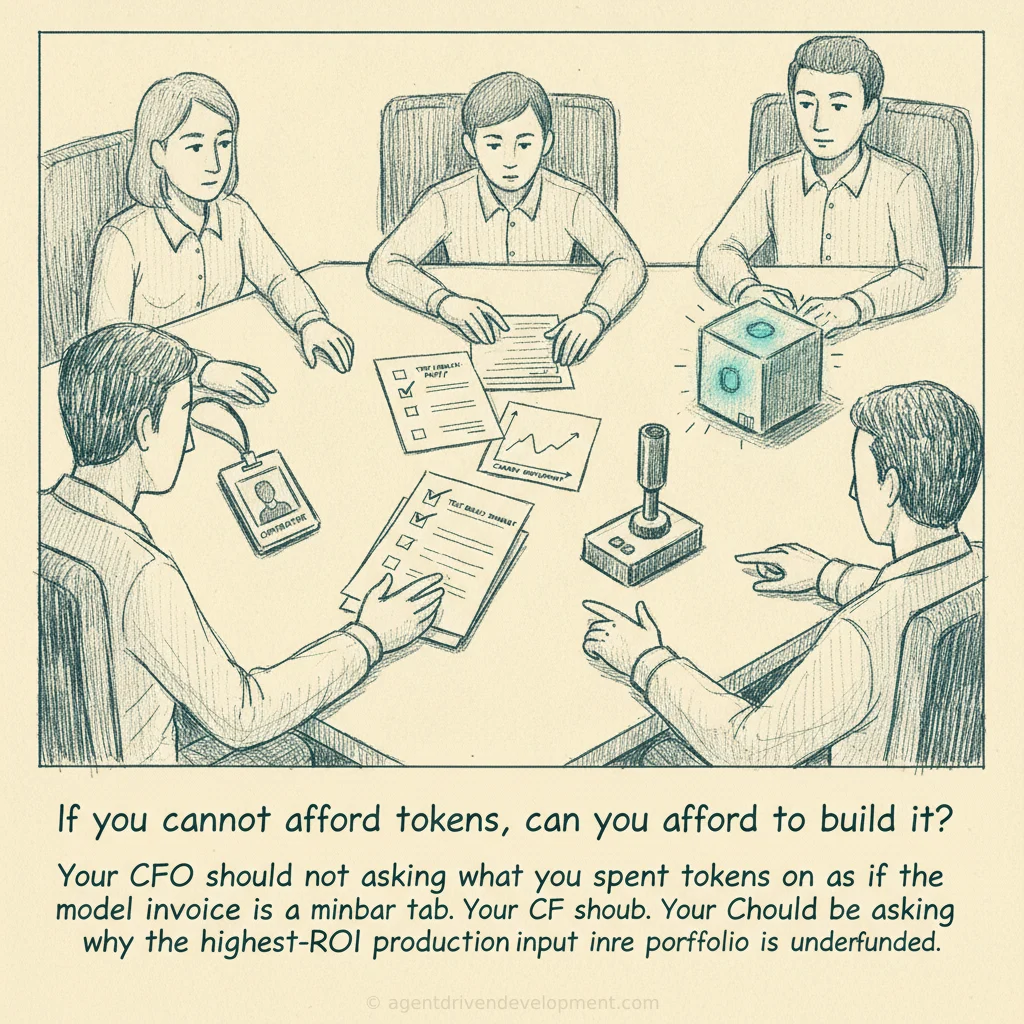
If you cannot afford the tokens, can you afford to build it?
Your CFO should not be asking what you spent tokens on as if the model invoice is a minibar tab. Your CFO should be asking why the highest-ROI production input in the software portfolio is underfunded.
Value stream economics are opaque when production inputs are not fully costed. Token expenditures expose this opacity.
Costing AI: Treat the AI invoice as capital, not expense.
An organization cannot manage its software portfolio effectively if it cannot articulate the value of a specific work item or accurately price the full cost of its production.
Model-based production costs must be compared against the total cost of the human-intensive alternative, inclusive of all hidden labor, coordination overhead, delay, and risk.
Decision-making to utilize AI should route work to the cheapest safe production path; this may involve small models, frontier models, or human judgment based on the specific context and risk.
Governance of AI spend requires defining the value hypothesis for the work, not merely placing universal caps on token consumption, which can lead to suboptimal production choices.
Delaying investment in AI capabilities while awaiting lower token prices incurs costs in lost learning, competitive disadvantage, and the perpetuation of inefficient operating models.
The first question for any AI program: what does this organization measure, and what does the measurement reward?
Value stream economics are opaque when production inputs are not fully costed. Token expenditures expose this opacity.
Costing AI: Treat the AI invoice as capital, not expense.
An organization cannot manage its software portfolio effectively if it cannot articulate the value of a specific work item or accurately price the full cost of its production.
Model-based production costs must be compared against the total cost of the human-intensive alternative, inclusive of all hidden labor, coordination overhead, delay, and risk.
Decision-making to utilize AI should route work to the cheapest safe production path; this may involve small models, frontier models, or human judgment based on the specific context and risk.
Governance of AI spend requires defining the value hypothesis for the work, not merely placing universal caps on token consumption, which can lead to suboptimal production choices.
Delaying investment in AI capabilities while awaiting lower token prices incurs costs in lost learning, competitive disadvantage, and the perpetuation of inefficient operating models.
The first question for any AI program: what does this organization measure, and what does the measurement reward?
After 20 years in software development, Norman is both a hands-on leader and defining the new age of AI SDLC for some of the biggest brands in the world — and exploring it with the builders. He writes here about things he is hearing and seeing. All posts are his personal points of view and do not reflect any employer or any customer he has ever had contact with.
The views and opinions expressed in this article are the author’s own and do not represent the positions of any employer, client, or affiliated organization.