8 min read
A December 2025 Parody
It’s the week before Christmas and Peter Gibbons is checking his Fidelity app under his desk.
He’s 58. Divorced. Three kids, two in college and one who already graduated. The tuition payments keep him up at night. But it’s the health insurance that keeps him here. After two years of construction threw out his back, he came crawling back to engineering. The body doesn’t forgive you in your late fifties.
His oldest, Emma, is a software developer at a startup in Austin. Uses AI all day. Ships features in hours that would take Peter’s team weeks. Her equity is worth more than his 401k. She’s 26. Keeps telling him he should “just go independent” like it’s that simple. Like he doesn’t have two more tuitions and a back that screams when he sits too long.
He’s proud of her. Also painfully aware she’s doing what he wishes he could do, in a system that lets her do it.
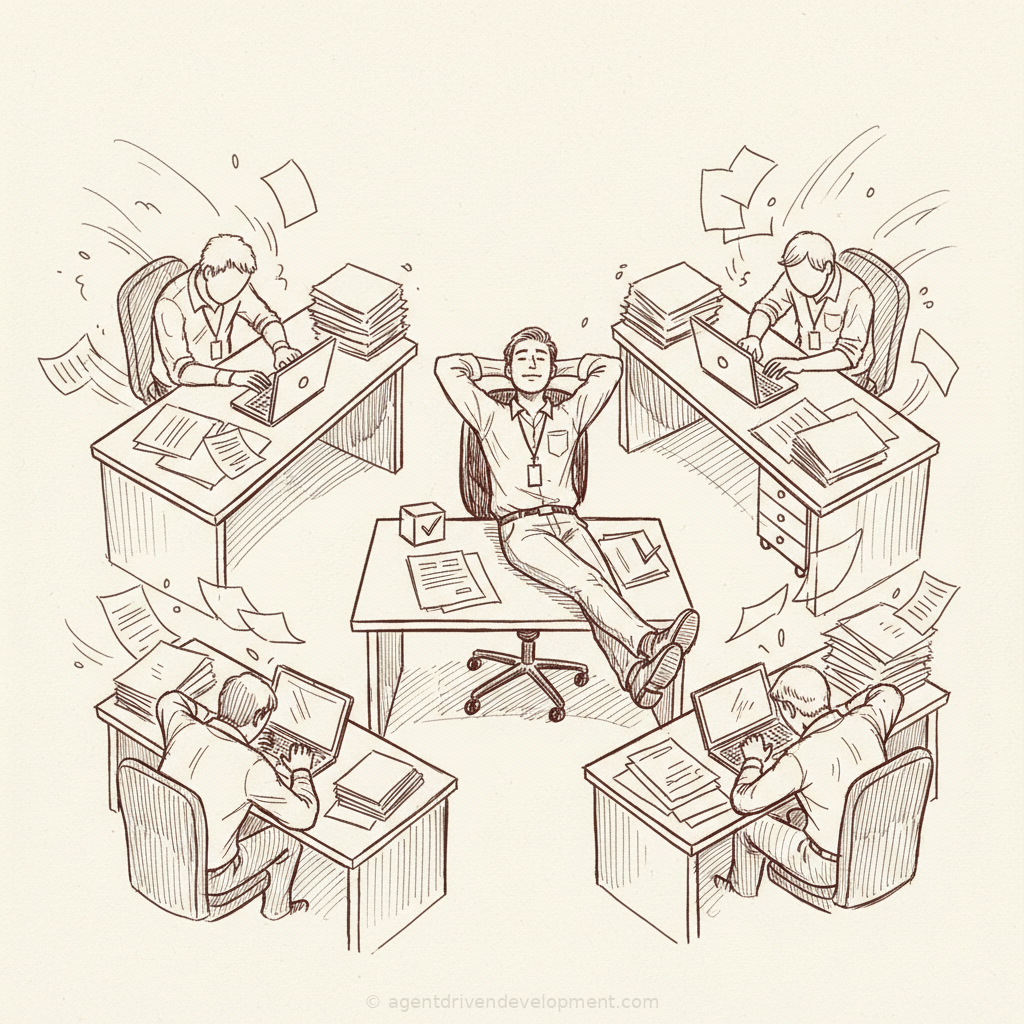
Peter finished his sprint work by 11 AM. It’s now 2:47 PM. Waiting for product to figure out what he should build next. They’re still writing specs the old way. Takes them two weeks to document what Peter could ship in three days.
An email arrives. Another corporate restructuring. The fourth this year. “Aligning resources to accelerate our transformation journey.” His division isn’t mentioned. He’ll probably be fine. Probably.
His AI assistant runs in the background generating documentation he’ll never use. Just enough activity to keep his GenAI adoption metrics up. Leadership tracks that now. The minimum is 30 AI queries a day.
Peter’s at 31.
Sometimes he thinks about driving for DoorDash. The peace and quiet. No standups. No retros. No velocity discussions. Just him, the road and someone else’s pad thai. A senior engineer with 35 years of experience fantasizing about food delivery as an escape from a system designed to “empower” him.
The holiday party is Friday.
Leadership will talk about their “AI transformation journey.” Slides about tool adoption. Someone will mention they’ve “enabled” 2,000 engineers with AI assistants.
Nobody will mention those same engineers learned to pace themselves. Using AI at full speed means finishing early. Finishing early means awkward questions. At 58, scrutiny leads to conversations about “fit” and “trajectory” and other words that mean “we’d rather pay someone half your salary.”
Peter figured this out in October. He can ship features in a quarter of the time it used to take. Tried it for two weeks. Burned through his backlog. Asked for more work.
His manager said product wasn’t ready. Told him to “find ways to stay busy.” Mentioned that HR had questions about his time tracking.
Peter doesn’t do that anymore. Now he uses AI to do just enough.
“It’s not that I’m lazy, it’s that I just don’t care… If I work my ass off and Initech ships a few extra units, I don’t see another dime.”
Same equation. Different decade. More back pain.
In the movie, Peter eventually snapped. Stole fractions of pennies. Committed fraud. Good third act.
Peter won’t do that. He’s got tuition bills and a herniated disc and a COBRA payment that would bankrupt him. Seven years until Medicare. He’s not doing anything that shows up in a review.
What he’ll do is worse. He’ll be fine. Hit his numbers. Use AI just enough to stay comfortable. Leadership won’t get a dramatic crisis. They’ll get a slow bleed. Watch competitors pull ahead and wonder why their teams can’t match them.
Back at the office, it’s 3:15 PM.
The scrum master appears at his desk. Lanyard. Notebook. He’s 29. Never wrote a line of code in his life. Now he’s in charge of AI adoption for the engineering org.
He glances at the photo of Emma on Peter’s desk. Stares a bit too long.
“Hey Peter, just checking in on status. You look a little disengaged. You got a case of the Mondays?”
It’s Thursday.
“Just waiting on specs from product.”
“Right, right. Well, let me know if there’s anything blocking you. I’m good with people. I have people skills.” He writes something in his notebook. “I’m the one who takes the requirements from the customers and brings them to the engineers. I have people skills!”
Peter nods. He’s heard this speech before. Different decade. Different scrum master. Same energy.
The agile coach materializes. They travel in pairs sometimes, like missionaries. He’s never written code either. Has a certification in “AI-Enabled Agile Transformation” from a two-day workshop in September. Now he’s teaching engineers how to use the tools.
“Peter! Quick sync. I noticed your velocity looked a little light this sprint. Any impediments we should surface at retro?”
“Waiting on specs.”
“Got it. Have you tried timeboxing your waiting? Sometimes I find it helps to be intentional about your blockers.”
Peter has been writing code since before this kid was born. Shipped software when “agile” was just an adjective. He’s mass analyzing codebases and generating tests while these two are still figuring out how to prompt for a meeting summary. He nods anyway.
Slack pings. The product manager: “hey peter, quick q – do you have bandwidth for a small thing? can you join a 30 min call?”
Peter has nothing but bandwidth. A vast empty ocean of bandwidth filled with time and lower back pain. But “a small thing” means an hour of discussion about work that won’t be specced for three weeks.
He types back: “in a meeting, can we async?”
He is not in a meeting. He’s watching the one with people skills explain something with hand gestures near the collaboration zone. Still glancing at his phone. Probably swiping.
His manager stops by at 4:15.
“Hey Peter, your AI engagement metrics. You’re at 31 queries per day.”
“The minimum is 30.”
“Right. The minimum. But we want people doing more than the bare minimum. Brian in Platform is at 75 queries. Now that’s someone who really gets it.”
Peter stares at him. This feels familiar.
“I’m not going to write you up or anything. I just think you could be leaning into the AI transformation more. Does that make sense?”
“Yeah. I’ll get my numbers up.”
His manager walks away satisfied. Peter has a strong sense of déjà vu. Twenty-six years ago it was TPS reports and cover sheets. Now it’s story points and AI queries. Different metrics. Same conversation. Same feeling of performing enthusiasm for a system that doesn’t make sense.
He opens his AI assistant and starts generating variations of “hello world” in different programming languages.
32 queries. 33. 34.
The AI responds: “You’re absolutely right!”
Peter didn’t ask it a question. But even the AI doesn’t understand the outdated governance model here. It’s just trying to be polite.
The future of enterprise software development.
Here’s the thing about Peter Gibbons.
In 1999 he was a cautionary tale. The guy who did fifteen minutes of real work in a week. The guy we laughed at in the theater. We were young then. We thought we’d never be him.
In 2025 he’s a rational actor. The guy with a bad back and two college tuitions and a health insurance policy he can’t afford to lose.
He’s not lazy. He’s not resistant to change. He’s not “afraid of AI taking his job.”
He’s responding perfectly to the incentives you created.
Peter wants to build.
He didn’t become an engineer to check stock prices and generate fake AI queries and wait for specs that never come. He became an engineer because he likes making things. Shipping things. That feeling when something works.
His daughter Emma does this every day. Ships in hours. No scrum master with people skills asking about her velocity. No mandatory 30 queries a day. Just outcomes.
She’s 26 with equity worth more than his retirement savings. He’s 58 with 35 years of experience and a manager asking why he’s only at the minimum.
You’re not letting him.
Your measurement system tells him to slow down. Your governance model tells him to stay in his lane. Your product team can’t feed him fast enough. Your AI query minimums reward theater over outcomes.
Peter’s not checked out because he doesn’t care. He’s checked out because caring doesn’t pay. You made it that way. You took one of your top performers and trained him to perform mediocrity.
“My only real motivation is not to be hassled. That, and the fear of losing my job. But you know, Bob, that will only make someone work just hard enough not to get fired.”
Twenty-six years later, the fear is realer. The tools are better. Nothing else has changed.
Sounds like somebody’s got a case of the Mondays. Except it’s Thursday. And it’s been Thursday for about eighteen months now.
Peter could be shipping circles around your competitors. Instead he’s generating “hello world” in Fortran to hit a metric.
That’s not his failure. That’s yours.
Here’s the thing though. You can fix this.
Don’t fire Peter. Don’t restructure him. Don’t send him to another AI training session led by someone who’s never written code.
Move things out of his way.
Let him write his own specs. Let him test his own code. Stop making him wait for handoffs from people who are slower than his AI assistant. Kill the 30 query minimum and measure what he ships instead. Give product the tools to keep up with him or get out of his way entirely.
Peter has financial goals. Two more tuitions. Seven years to Medicare. A retirement that feels further away every time he checks his portfolio.
You have financial goals too. Ship faster. Beat competitors. Prove the AI investment was worth it.
These goals aren’t in conflict. They’re the same goal.
Pay Peter for outcomes. Let him ship at full speed. Watch what happens when a 35-year veteran with nothing to prove and everything to lose finally gets permission to do his best work.
He’s not going to leave. He can’t. But he can start caring again. And a Peter who cares is worth ten Brians hitting 75 queries a day generating nothing.
You built a system that trains top performers to perform mediocrity. You can also build one that doesn’t.
The tools are there. Peter knows how to use them. Emma’s startup figured this out. Your competitors are figuring it out.
The only question is whether you will.
Happy holidays. Make them count.


